
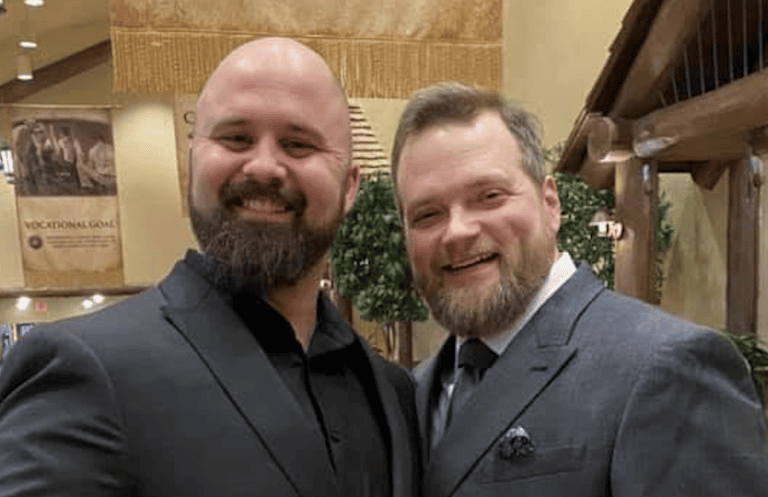
Long before Brad Youngblood thought about developing the land surrounding one of Table Rock Lake’s most recognizable landmarks, he was jumping off its cliffs.
Table Rock Lake is one of the nation’s most iconic destinations, but when Youngblood was 8-9, Battleship Rock was simply one of those places local families revered. Families would load a boat with kids, head toward the cliffs and everybody understood the destination.
Decades later, Youngblood has found himself on that same terrain for an entirely new reason.
As he was scouting possible development grounds in the Branson area, one particular parcel caught his attention. It had some challenges. But as Youngblood walked the property, he realized something he hadn’t understood from the listing: the land connected directly to Battleship Rock.
His reaction was immediate.
“This is incredible,” he remembers thinking.
He called longtime colleague Jeramie Worley. The two eventually stood together overlooking the cliffs and reached the same conclusion: For multiple reasons, this was a project they had to pursue.
The property is now becoming Victory Springs, a nature-first hospitality development moving into its first stage of construction near Table Rock Lake.
For Worley, a longtime short-term-rental specialist, author and commercial real estate broker, the project has brought together two decades of thinking about hospitality, guest experience and real estate investment.
For Youngblood, Victory Springs represents all of these things, and more: It’s the example of the kind of project he particularly loves in a career that regularly sees possibility where others may primarily see “property.”
From Utility Lines to RE
Youngblood did not set out to become a resort developer.
Early in his career, he worked as a utility locator, spending his days in the field identifying underground infrastructure. A knee injury eventually made that work impractical and forced him to consider another direction.
Technology wasn’t exactly his advantage.
Youngblood remembers operating largely from a flip phone and using a laptop mainly to look at utility maps. Email wasn’t part of his normal existence.
Real estate, however, turned out to be.
According to Worley, who knew Youngblood near the beginning of short term renting’s big transition, the newcomer promptly began breaking sales records at their brokerage. While many agents were handling $1 million to $3 million in annual volume, Worley recalls Youngblood reaching roughly $6 million. The brokerage eventually created an internal Brad Youngblood Award.
Yet one detail may reveal more about Youngblood than the sales numbers.
As one of the organization’s most successful agents, he regularly returned to help incoming agents get started, sometimes even showing up with biscuits and gravy in hand. These steps fit a pattern that would continue throughout his career: Do the work. Learn how the system functions. Then figure out what else is possible, too.
Eventually, selling other people’s real estate wasn’t enough.
Youngblood began acquiring equity positions himself, partnering on properties, working in resort development and helping build a property-management operation with his wife, Michelle. He moved increasingly close to the physical side of development as well, becoming involved in excavation and construction operations.
Worley has a simpler description for his partner: Brad is “the hammer”– the person who invariably figures out how to get something done.
An Eye for the Unusual
Youngblood’s instincts don’t tend to lead him toward conventional properties. For example, several years into his real estate career, as he was scrolling through Facebook looking at property around Jasper, Arkansas, he saw an Ozarks community he particularly liked.
Then something unusual caught his eye.
It was roughly 80 acres containing a house — as in a literal home dwelling – incorporated into a natural cave.
Youngblood and his partners acquired the property with plans to refurbish and expand on its potential. Eventually the home drew interest from HGTV’s Zillow Gone Wild, hosted by Jack McBrayer (most well known as the character Kenneth Parcell on 30 Rock), based on the premise of finding homes that defy all real estate norms.
The property became the episode winner of Season 3, episode 6.
Youngblood, perhaps appropriately, wasn’t the person clamoring to be in front of the camera.
“I’m the guy behind the scenes,” he says. “Just making things happen.”
Other partners handled the television attention.
But the experience underscored something about Youngblood’s career that would matter later at Victory Springs: He is attracted to the elements every property possesses – particularly in natural settings — that can’t simply be manufactured somewhere else.
A cave can’t be recreated authentically. And neither can a cliff that’s been part of generations of memories.
When the Opportunity Isn’t the Bargain
Youngblood wasn’t initially looking for Victory Springs for himself. He’d been asked to identify possible land for another development group and brought forward several candidates. The parcel adjoining Battleship Rock was one of them.
The original group ultimately didn’t pursue it. But Youngblood couldn’t forget it.
Real estate investing frequently trains buyers to search for the “deal”: distressed pricing, a motivated seller, a hidden financial upside. But Youngblood and Worley saw something different at Battleship Rock. They saw an opportunity worth pursuing even without the proverbial “twist.”
In fact, Worley recalls that they paid more per acre than others had paid for comparable land because they believed the property’s irreplaceable characteristics changed the equation.
That decision, between buying something cheaply and recognizing something unusually valuable, has become central to Victory Spring’s entire approach.
A Delay That Changed the Development
Victory Springs’ initial path to construction was not smooth. The need to answer questions and work through surrounding property concerns about access and development resulted in an extended legal and regulatory detour before the project could advance.
But Youngblood sees an unexpected benefit in the delay. The original plan could have been relatively conventional: to develop the land, divide it into lots and sell them.
Time and careful consideration evolved the team’s thinking.
“This ground was so much more than that,” Youngblood says.
The partners moved to retain the property as a unified destination, to attract investment around it through a much broader lens of enriching experiences and opportunity, and to preserve much more of what made the location remarkable in the first place.
The emerging philosophy became not simply nature-forward development, but development in which nature itself remains the principal asset.
This matters to Youngblood and Worley greatly. Once a mature landscape is leveled, particularly in an iconic location, removal of expansive trees, ancient rock formations altered or the essential character of a site changed creates a condition no architectural budget can restore.
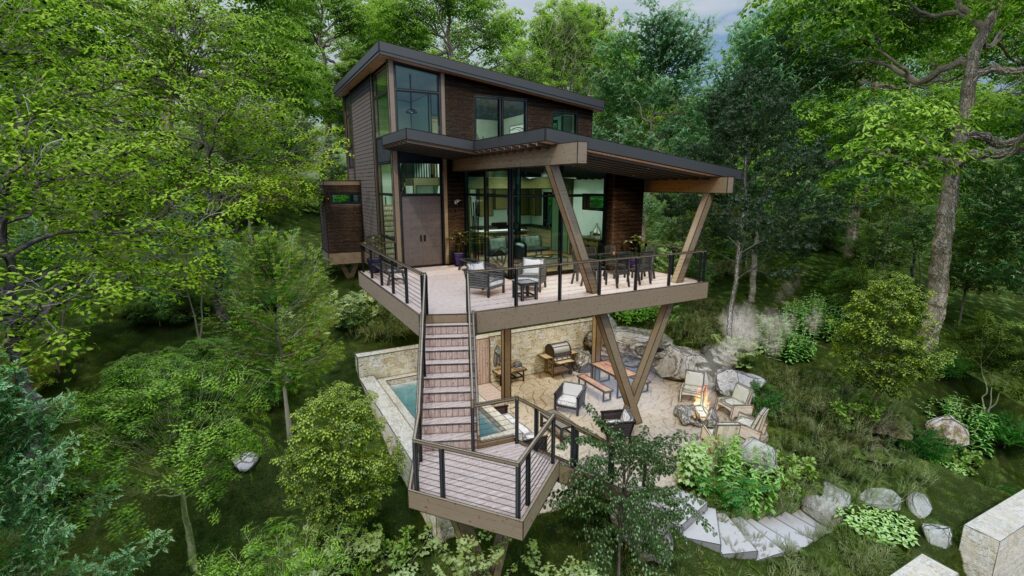
So, Victory Springs has been planned around preserving mature trees where practical, integrating structures with the terrain and minimizing unnecessary disruption to the property.
For Youngblood and Worley this is far more than an environmental philosophy. It is also hospitality strategy.
Testing the Experience Before Building It
Youngblood has an unusual advantage for a developer making assumptions about what vacation travelers want: Like Worley, he has spent years observing what they actually choose.
Through the property-management business operated by Brad’s wife Michelle and her sister, the team has been able to test elements of the experiential hospitality concept in existing properties.
Some of the experiments sound deceptively simple, such as taking smaller rental properties and dramatically improving the outdoor experience with amenities such as private hot tubs, saunas, fire pits, string lighting and outdoor movie setups where guests can watch a film from the water.
The results have been consequential enough to influence Victory Springs.
Worley notes that from an investment standpoint, some enhanced two-bedroom properties have generated revenue comparable to larger four-bedroom units. That experience also reinforces a principle Youngblood and Worley have both come to believe deeply: Guests don’t necessarily remember square footage. They remember what happened while they were there.
“I love to get creative with experiences,” Youngblood says. The objective isn’t merely for somebody to report that a rental was comfortable. He wants to create something “they’ll never forget before they leave,” and something compelling enough to bring them back.
Knowing When Not to Build
This philosophy creates an interesting tension for somebody whose business is development.
Developers make money by creating things. But Youngblood increasingly believes success is also determined by providing the backdrop for lived experiences, and in knowing what not to change.
He and Worley have spent enough years in real estate to understand that almost any sufficiently financed project can be made bigger, denser or more elaborate. But the better question is whether it should be.
As the partners have put it: “Just because we can doesn’t mean we should.”
Victory Springs may be the largest test yet of that philosophy.
In Youngblood’s case he has evolved from a utility locator who knew the physical terrain beneath other people’s projects, to a real estate agent, owner, operator, property manager and now a successful developer creating unique RE of his own.
Now he is helping develop a piece of land he knew before any of these titles applied to him.
Perhaps this is why the cliffs look different to him. A developer arriving for the first time can see acreage. But Brad Youngblood can still see the place where an eight-year-old boy experienced the pure joy of jumping into Table Rock Lake.
Ideally, Victory Springs is striking the ideal balance – Creating a project that is valuable on every level without erasing the beauty that compelled that young boy to jump in.