

For years, red light therapy occupied a strange corner of the wellness market. The technology had real clinical roots, serious athlete adoption, and growing interest from the longevity crowd, but access was limited. You either booked sessions at a med spa or recovery clinic, often paying $100 to $300 per visit, or you bought a consumer device that looked convenient but did not match the performance of professional-grade equipment.
That gap is exactly where Mito Red Light has built its business.
The brand is part of a broader shift in wellness and performance: tools once reserved for clinics and deep-pocketed biohackers are moving into the home. Not as watered-down gadgets, but as engineered devices built for daily use. For entrepreneurs, executives, and high-output professionals, the question is no longer whether recovery and skincare are worth investing in. It is whether they want to keep renting access to those tools or own them outright.
Red Light Therapy Moves From Clinic to Countertop
Red light therapy is not new. Specific wavelengths of red and near-infrared light have been shown to support cellular function, skin health, circulation, and recovery — which is why it became a fixture in dermatology offices, sports recovery studios, and biohacking circles alike.
What has changed is the access model. A decade ago, using red light therapy regularly meant scheduling appointments, commuting to a clinic, and paying per session. That does not fit the way high-performers build habits. The routines that stick are the ones that reduce friction, not add to it.
Mito Red Light’s thesis: bring clinical-grade light therapy home, and people will actually use it. Two products anchor that idea.
MitoGLOW Reframes the At-Home LED Mask
The MitoGLOW LED Face Mask is FDA 510(k)-cleared for wrinkles and acne, and engineered around the limitations that hold most consumer LED masks back.
The most notable difference is diode count — 1,064 individual LED chips, eight times more than Omnilux, the benchmark consumer mask. Even coverage across the full face matters more than most brands acknowledge. The MitoGLOW also uses four targeted wavelengths spanning blue, amber, red, and near-infrared, covering a wider range of skin concerns than single-wavelength masks.
The hover-fit design keeps the mask off the skin for better light diffusion, built-in eye protection removes the need for separate goggles, and a patent-pending rotatable chin and neck module extends treatment beyond the face — something no competitor at this price point offers.
MitoPRO 300X Brings Recovery Into the Daily Routine
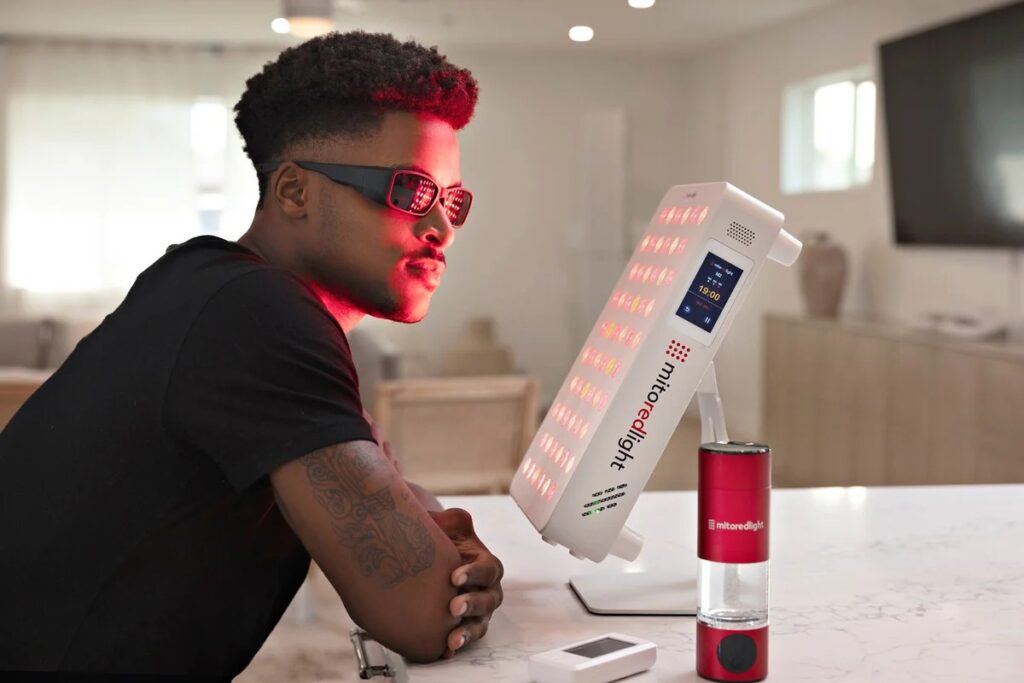
The MitoPRO 300X Panel Series is the performance-focused counterpart — a medical-grade panel built for people who treat recovery as part of how they operate.
The panel uses six wavelengths of red and near-infrared light, designed to support muscle recovery, circulation, joint health, and skin from a single device. Multiple sizes are available, from the targeted 300X to larger panels for broader coverage.
The use case is straightforward: entrepreneurs, active parents, and desk-bound professionals who train hard but cannot build a weekly recovery appointment into their schedule. Ten minutes at home, repeated consistently, compounds in a way that occasional clinic visits simply do not.
The Founder’s Math
A med spa LED facial costs $100 to $300 per session. Recovery services stack up even faster over the course of a year. Against that backdrop, a $499 mask or a $449 panel is not just a wellness purchase — it is a capital allocation decision. Plus, both the MitoGLOW and MitoPRO are also HSA- and FSA-eligible
Buy the tool once, use it repeatedly, and stop depending on someone else’s schedule to maintain your own. That is the value proposition in plain terms.
At-home devices do not replace every professional treatment, and anyone with medical concerns should consult a provider. But for routine maintenance and recovery, ownership beats access — and the more consistently someone uses red light therapy, the more that holds true.
More Machines, More at Home
The direction is clear. More and more of what used to require a clinic visit is now available as a device you buy, set up at home, and use on your own schedule. Red light therapy is following the same path.
Mito Red Light is betting that high-performers do not want more wellness theater. They want tools that are specific, measurable, and easy to build into daily life. The MitoGLOW and MitoPRO 300X deliver on that — one for skin, one for recovery, both designed to replace the appointment with something you actually own.
Red light therapy used to feel like something you booked. Increasingly, it looks like something you own.