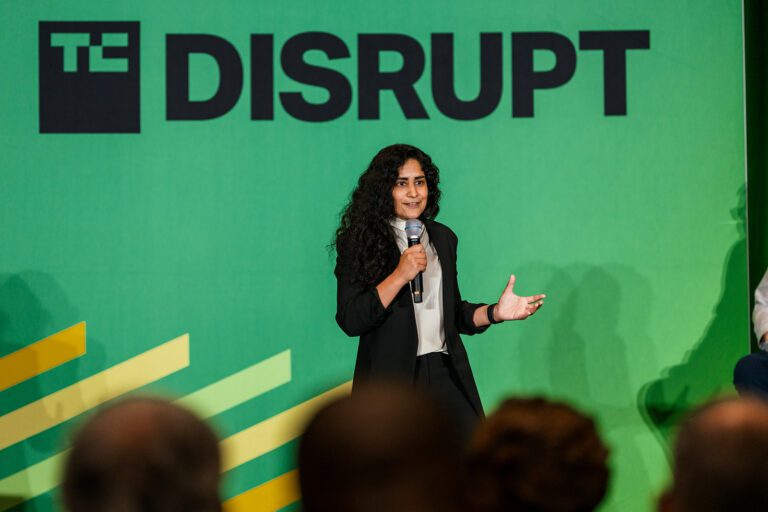
Alisha Esmail built an award-winning coffee brand, Road Coffee, in one of the world’s most saturated markets. In the process, she became a client retention expert. She then built an AI-native SaaS platform called Latch AI, supported by Martell Ventures, that helped businesses detect customer drift and prevent churn. And while speaking at TechCrunch Disrupt 2026, she announced the acquisition of Latch AI, marking a successful exit from the company she founded.
95% of AI pilots fail. Not because the technology is bad. Because the implementation is. And after spending four years building with AI, then building an AI company from the ground up, Alisha now understands exactly why. She’s spent the last year talking to over 500 companies, and the pattern is unmistakable: businesses are caught between two extremes. On one end, companies are overwhelmed by AI tools, building random dashboards that don’t serve their business and frustrating their teams. On the other end, founders are too scared to use AI at all, paralyzed by complexity and uncertainty. Neither approach moves the needle.
“I’ve been building with AI for four years,” Esmail said. “I built Latch AI to prove that an AI-native company could work. Now I’m helping other businesses do the same — but without the chaos, without the waste, and without replacing people.”
From Retention Expert to AI Builder
It started with coffee.
Road Coffee began as a mission to help coffee farmers move out of poverty into independence and freedom. Esmail built direct supply chains around the world, three of them fully female-owned. She partnered with the first women care certified coffee farm in Costa Rica and launched microloan programs in Peru. The brand won awards and built a loyal customer base.
But success came with a hard lesson. Seven years into building Road Coffee, her largest client – representing 50% of monthly revenue – sent an email: “We’ve decided to go in a different direction.” She thought everything was fine. She knew people at the company. She was friends with some of the C-suite. But she wasn’t listening to the silent signals: slower response times, shorter communications, a shift in tone.
“That moment changed everything,” Alisha recalled. “I realized I had to become a retention expert. If I wanted to build a sustainable company in one of the most competitive markets in the world, retention wasn’t optional. It was essential.”
She tripled retention for Road Coffee. And then she realized other businesses faced the same problem. Most founders focus on top-of-funnel sales while their existing clients slip away unnoticed. It’s a pattern so common that Esmail has a name for it: the war on clients.
Building Latch AI: The AI-Native Retention Engine
That insight led to Latch AI. The platform connected to the systems businesses already used; HubSpot, Stripe, Slack, GoHighLevel, and more- to analyze client engagement signals and surface actionable insights. It categorized every client into one of three health tiers: at risk, stable, or ready for expansion. And it delivered hyper-personalized follow-up recommendations, not generic templates.
Early results were significant. One client identified over $650,000 in missed revenue opportunities during a single quarter. Another discovered nearly $500,000 in recoverable revenue through better retention practices. These weren’t new revenue figures. They were revenue that was already being lost through silent churn and neglected follow-ups. Another client gained 77 additional paid appointments, including new patients in her first eight weeks working with Latch AI. Another client grew their retention by 3.6% in a single quarter.
Latch AI served marketing agencies, SaaS companies, coaches, and clinics. The platform was lightweight, easy to implement, and designed to be a retention co-pilot for teams without dedicated customer success resources.
During her presentation at TechCrunch Disrupt 2026, Alisha Esmail announced the acquisition of Latch AI by General Magic Inc., a healthcare technology company focused on simplifying how clinics operate.
“I didn’t build Latch AI because I read a market report. I built it because I lived the problem. A few years into Road Coffee, my biggest client walked away and I never saw it coming. That moment taught me that retention isn’t a department, it’s a discipline. Latch AI was my answer to that lesson, and exiting in under a year proved that founders are desperate for this solution.” Shares Alisha Esmail.
“Now I’m taking everything I learned building and exiting an AI company and helping other founders implement AI without the chaos, the waste, or the burnout.”
But for the 2x successful founder personally, the exit marks a transition and not just a conclusion.
The Real Problem: AI Implementation
Over the past year, while building Latch AI, she spoke to over 500 companies about their AI challenges. The conversations revealed a crisis that most business leaders aren’t talking about: 95% of AI pilots fail, and it has nothing to do with the technology itself.
“I’ve seen both extremes,” Alisha explained. “On one side, companies are throwing AI at every problem. They’re building dashboards, automating workflows, integrating tools, but they’re not asking the right questions first. Their processes are broken. Their systems are fragmented. So they’re just getting broken faster. On the other side, founders are paralyzed. They’re scared of AI. They don’t understand it. They think it’s going to replace their team. So they do nothing.”
What she discovered is that most businesses try to layer AI on top of broken foundations. They don’t fix the underlying systems first. They don’t think about what they’re actually trying to solve. And they don’t involve their teams in the process.
“AI should buy back your time, not bury you in tools,” Esmail said. “And it should never replace people. It should empower them to do what only they can do.”
The Five Tanks Framework: Scaling Without Burnout
Alisha Esmail’s approach to sustainable growth is grounded in the Five Tanks Framework, a holistic system she created for founders. The framework addresses five dimensions: Mental, Emotional, Physical, Relational, and Spiritual. It’s designed to help founders scale their businesses without sacrificing their well-being in the process.
This philosophy directly informs her approach to AI implementation. Technology should serve the founder and the team, not consume them.
“When I was building Road Coffee, I learned that you can’t build a sustainable business if you’re burning out,” She said. “The same applies to AI. If you’re implementing AI in a way that creates more chaos, more confusion, more work for your team, then you’re doing it wrong. AI should simplify. It should clarify. It should give people back their time.”
What’s Next: AI Implementation for Real
Alisha is now focused on her next venture: helping businesses integrate AI in a way that actually moves the needle. Not flashy dashboards. Not random automation. Not replacing people. Real implementation that solves real problems. She’s a founder who has built with AI for four years, built an AI company, and exited it. She understands both the promise and the pitfalls.
“I want to work with founders and executives who are serious about AI,” She said. “Not the ones who want to check a box. The ones who want to actually move the needle. I’ve spent four years learning what works and what doesn’t. I’ve built an AI company. I’ve exited it. Now I want to help other businesses do the same. But faster, smarter, and without the waste.”
For Alisha Esmail, the TechCrunch stage wasn’t just a moment to announce an acquisition. It was a moment to announce a new chapter. One where her expertise in building, scaling, and exiting an AI company becomes the foundation for helping other businesses get AI right.