Most people learning engineering today are doing it on screens.
They watch tutorials. They simulate circuits. They drag components across digital interfaces that behave exactly as intended.
And then they’re asked to build something real.
That gap—between understanding a concept and physically making it work in the real world—is where most engineering education breaks down.
Angie Mercurio, a robotics engineer and founder of nLab, didn’t fully understand the scale of that problem until she was already inside it.
“I graduated with an A+ in circuits,” she says, “but I never actually built one.”
The issue wasn’t that the material was too difficult. It was that she had been trained to recognize systems—not create them.
And that distinction matters more now than ever.
As AI rapidly automates software-based work, the most durable skills are shifting back toward the physical world—toward systems you can touch, debug, and understand through failure instead of prediction.
That’s the gap nLab is built to close.
Why Engineering Education is Broken – and How nLab Fixes It
Most engineering tools today are designed for certainty.
If you follow the steps, the system works. If it doesn’t, the assumption is usually user error.
But real engineering doesn’t behave that way.
Circuits fail for subtle reasons. Signals degrade. Components interact in nonlinear ways that don’t show up in simulations. Debugging becomes less about following instructions and more about understanding what a system is doing under imperfect conditions.
That’s where most learners get stuck—and where most education quietly stops helping.
nLab was built on a different assumption: uncertainty is not a flaw in learning engineering. It is the point.
Instead of removing ambiguity, nLab brings learners closer to it—safely and early—so they can develop real intuition instead of procedural memory.
What nLab Is: A Lab for Everyone
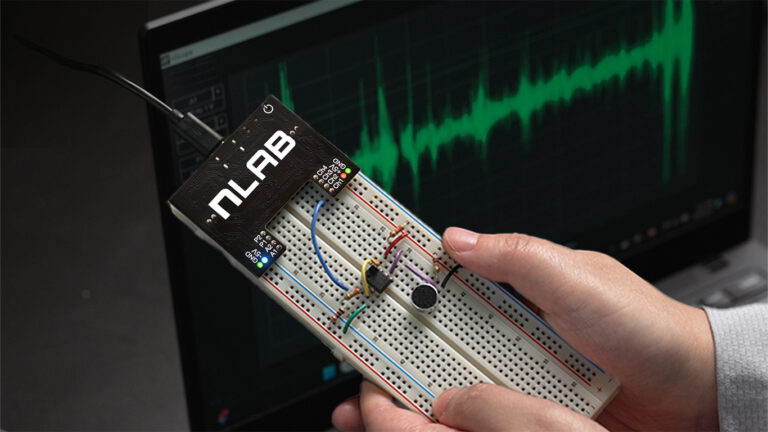
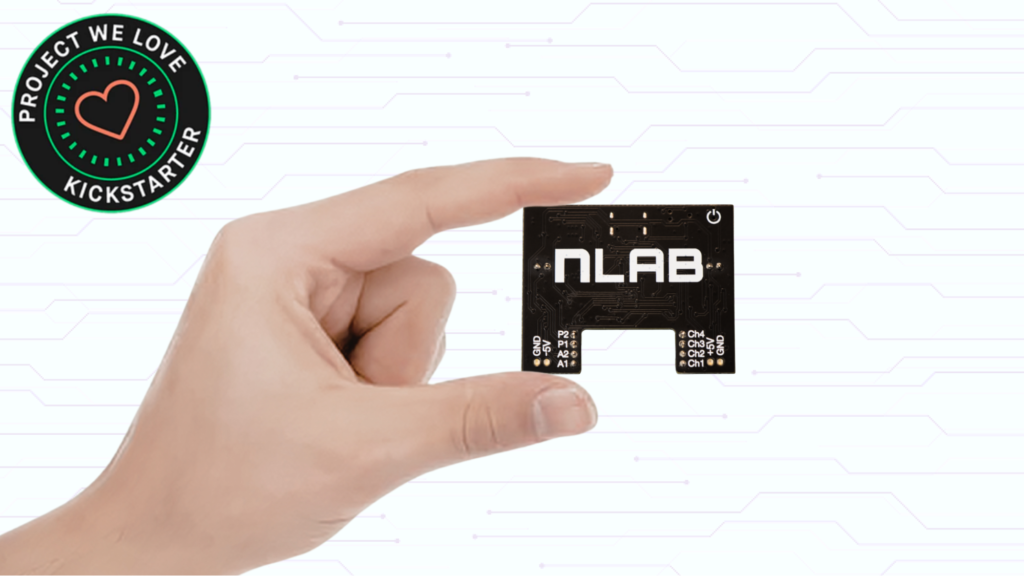
nLab is a pocket-sized electronics lab that compresses an entire engineering workspace into a single system.
The Starter Kit includes everything you need to build circuits:
- a 4-channel oscilloscope
- function generator
- bipolar power supply
- desktop app
- 200+ electronic components
- guided projects
- free YouTube tutorials
Instead of spending thousands on lab infrastructure—or tens of thousands on a degree just to access it—learners can start building real systems immediately.
Traditional engineering education forces a tradeoff: limited lab time, shared equipment, and rushed experiments that end before real understanding can form. Most learners never get enough repetition with real systems to actually build intuition.
nLab removes that constraint entirely. It turns engineering from something you schedule, into something you can practice anytime, anywhere, at your own pace.
For Adult Beginners, Makers, Professionals—and Everyone in Between
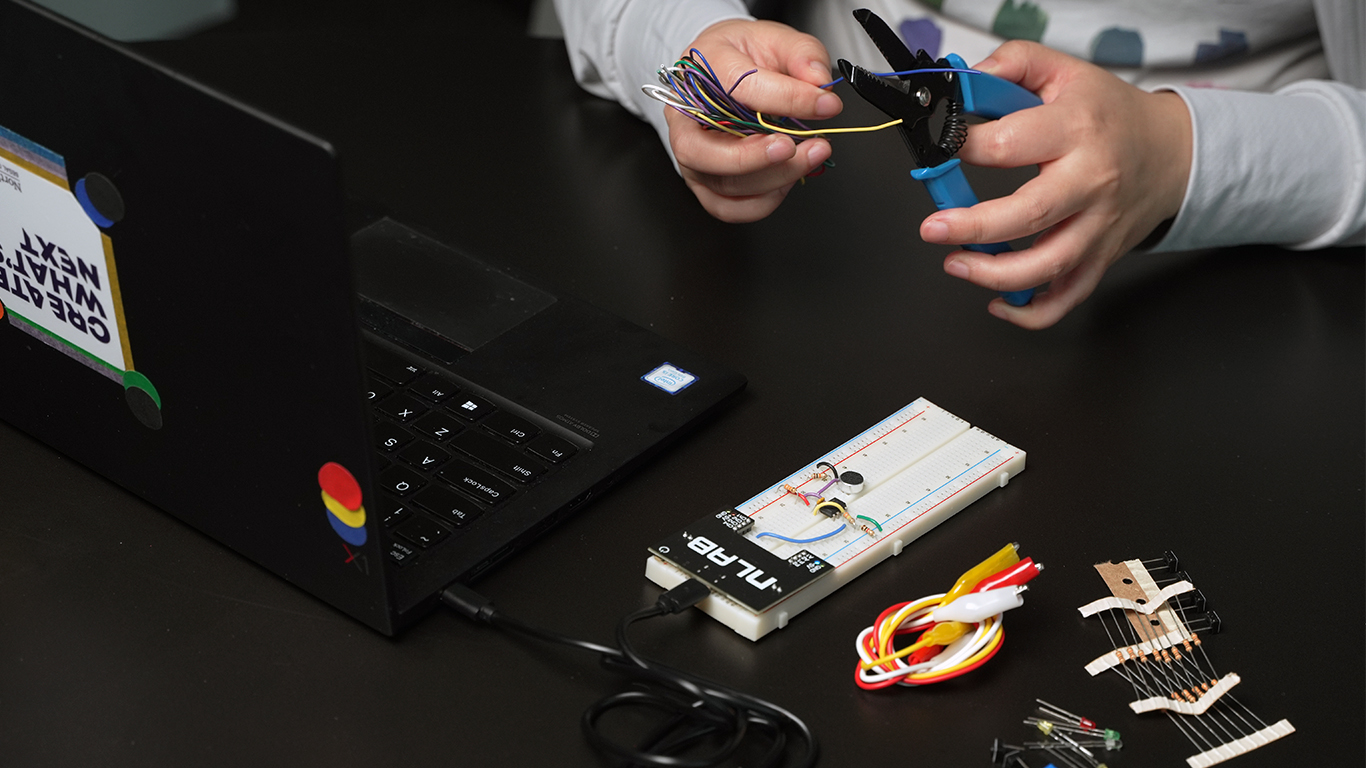
nLab is designed for people at every stage of learning:
For beginners
Build your first working circuit in minutes with step-by-step guidance.
For makers
Bring your ideas to life while understanding what’s happening at every step.
For professionals
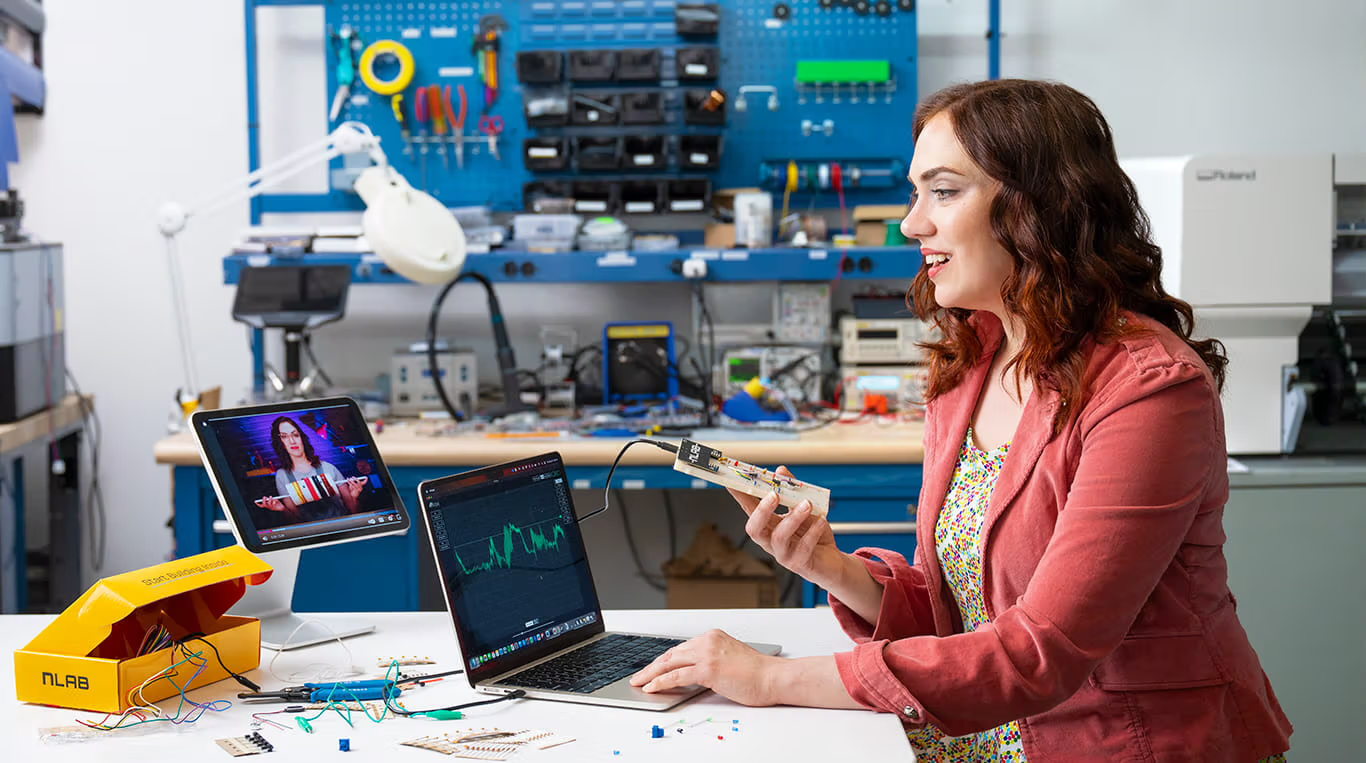
Carry a complete electronics lab and debugging tool wherever you go.
It’s not just a learning tool—it’s an onramp into hardware, whether you’re starting from zero or already building systems at work.
From Frustrated Student to Disney Imagineer—and Now CEO of the Company That Got Her There
Angie started as a disillusioned engineering student who understood theory but struggled to actually build physical systems independently.
Like many students, she could pass exams—but hadn’t yet developed intuition for how circuits behaved in the real world.
That changed when she encountered early versions of what would become nLab at Northwestern University.
For the first time, she wasn’t just studying electronics—she was building them repeatedly, independently, and in a way that reflected real system behavior rather than idealized diagrams.
That shift changed her trajectory.
She began building a hands-on portfolio of electronics projects—proof not just of knowledge, but of capability.
Among the creations she made with nLab were a smart makeup mirror, a “good morning” button that walked her through her morning routine, and her master’s thesis – a piece of jewelry that can alert authorities with a subtle press (and hold) of a button.
That portfolio ultimately helped her land a role as a Disney Imagineer, working on real-world entertainment technology systems where engineering meets experience design.
But the insight that followed was sharper.
The tool that helped her break into one of the most competitive creative engineering environments wasn’t widely accessible to the students still stuck at the starting line.
So she returned to build it into something anyone could access. Today, she is CEO of nLab, scaling the same system that changed her trajectory so others can take the same path.
The Hidden Bottleneck in Engineering Today
The demand for engineers is accelerating across robotics, climate tech, manufacturing, and AI hardware systems.
The constraint is no longer interest or theory—it’s the documented global shortage of people with electronics and hardware engineering skills needed to build physical systems.
Traditional engineering education struggles with this translation layer. Labs are expensive, access is limited, and most students graduate without ever independently building a full system from scratch. Even when they understand the concepts, they rarely get enough time with real equipment to develop intuition through iteration.
That lack of repetition is the quiet filter in engineering education. It determines who gets fluent in systems—and who never gets past theory.
nLab was designed to change that by giving learners a complete engineering environment they can return to continuously. The entire system is built around repetition, experimentation, and failure in real physical circuits.
Because engineering understanding doesn’t come from seeing a system work once. It comes from working with it long enough to recognize why it fails.
When something doesn’t work, learners can observe the actual system behavior:
- signal noise
- broken connections
- incorrect assumptions in wiring or design
Over time, that shifts problem-solving from guessing to reading the system itself.
And that repeated exposure to real failure modes is what builds structured debugging intuition—the foundation of real, applicable engineering skills.
Learn How Technology Works By Building It From Scratch
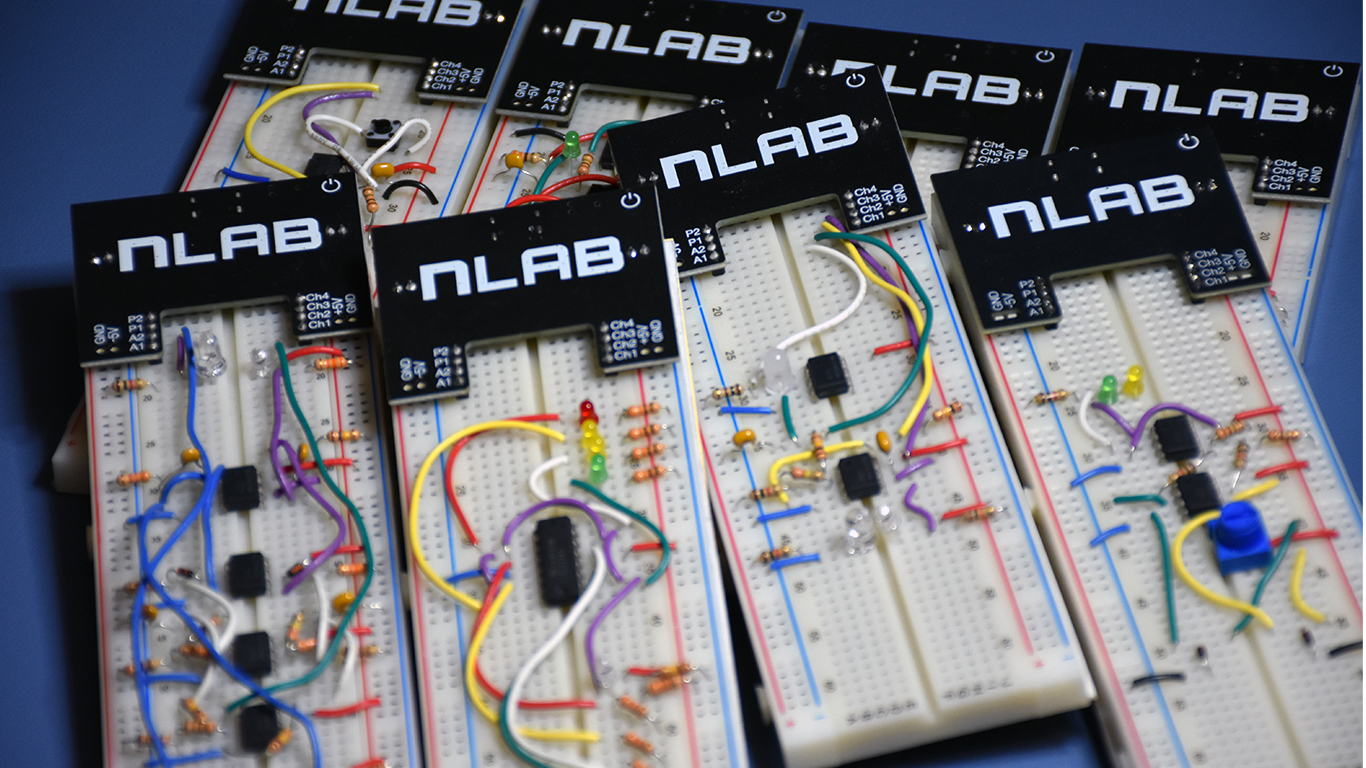
The nLab Starter Kit has you build towards destination projects like:
- heartbeat monitors
- pianos/synths
- game controllers
- climate sensors
- signal processing systems
Each one teaches not just what works—but why systems behave the way they do in reality.
And that matters more in an AI-driven world, not less.
Because while AI can generate explanations instantly, it cannot replace the experience of physically debugging reality.
nLab Is Redefining How We Reskill for the Future
Engineering education didn’t fail because people stopped being curious.
It failed because access to real systems became too constrained, too expensive, and too abstract.
nLab is an attempt to reverse that.
Not by simplifying engineering—but by putting real systems back into learners’ hands early enough that intuition can actually form.
Because the most AI-proof skills aren’t learned on a screen.
They’re built.