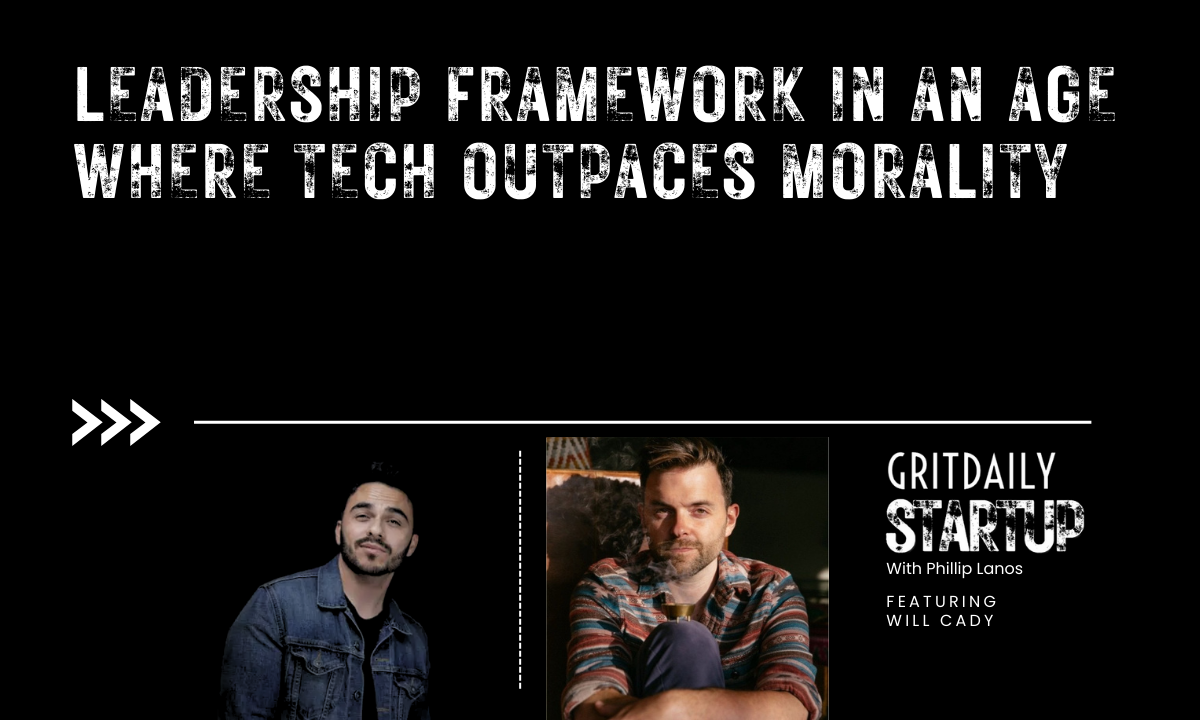
As artificial intelligence accelerates the capabilities of modern organizations, Will Cady believes the real risk is not technological, it is philosophical. The founder of HEAL MVMNT argues that innovation is advancing faster than the moral frameworks needed to guide it, leaving leaders responsible for decisions that previous generations never had to contemplate. In response, he is developing a methodology designed to help companies align their values before scale magnifies their consequences.
HEAL MVMNT is structured as a counterpart to STEM. While science, technology, engineering, and mathematics have shaped how businesses build and optimize, Cady sees an urgent need for a parallel container rooted in the humanities. HEAL focuses on storytelling, community cohesion, and ethical decision-making, tools he views as essential for navigating a world where emerging technologies make previously impossible actions routine.
For now, the work is centered on organizations, where leadership choices ripple quickly across employees, customers, and digital audiences. Cady frames the effort across three interconnected layers: online community, company culture, and leadership development. Each ultimately answers the same question: what does a brand mean, and what story are people being asked to join?
His approach is informed by an unconventional career path that blends creative strategy, music, and cultural analysis. During his time leading creative strategy initiatives at Reddit, colleagues nicknamed him the “shaman of Reddit,” a reflection of his role as both strategist and internal guide. Beyond traditional brand work, he facilitated meditations, encouraged deeper reflection about organizational identity, and helped teams articulate the narratives shaping their decisions.
At the center of that work was what he describes as “vision keeping,” the discipline of maintaining alignment while translating one core story across many audiences. It is a responsibility he likens less to a job and more to a vocation.
The roots of that perspective stretch back to childhood. Cady recalls watching his father anchor a drum circle by simply holding the rhythm while others improvised around it. Later, as a bass player, he adopted the same function, grounding musical complexity with a single stabilizing note. The lesson became foundational: effective leadership is not always about commanding attention, but about creating coherence so that dissonance resolves into something meaningful.
That metaphor now informs how he advises executives. A leader, in his view, should set the tone, harmonize competing priorities, and maintain tempo during moments of uncertainty. Power and humility, he suggests, must operate simultaneously.
HEAL MVMNT’s client work reflects this philosophy across a wide spectrum. Some engagements involve recognized consumer platforms seeking clarity around what they stand for. Others sit at the intersection of culture and commerce, such as immersive experiential brands powered by artist collectives. At the far end are collaborations with groups carrying generational knowledge about community resilience, offering frameworks that predate modern corporate structures by centuries.
Despite their differences, these partners share a common tension between purpose and profit. Cady does not see the two as mutually exclusive, but he is clear about their hierarchy. Profit fluctuates with markets, while purpose provides continuity through periods of change. Organizations that define their purpose, he argues, gain the strategic patience required to think beyond quarterly cycles and plan on the scale of decades.
That long-term orientation is particularly critical as companies integrate AI into their operations. Automation can optimize workflows, but it cannot replace the human responsibility to decide what should be optimized in the first place. Cady points to the growing emphasis on keeping a “human in the loop,” the idea that at decisive moments, judgment must remain human.
History offers stark reminders of why. A single intuitive decision by a military officer once prevented a catastrophic nuclear response after a system error signaled an incoming attack. While extreme, the example underscores a broader truth: technology executes, but humans interpret.
In business, the stakes may be less existential but no less consequential. AI can accelerate success, yet it can just as easily scale misalignment. Even a slight deviation in values, Cady notes, compounds over distance, much like a spacecraft drifting off course by a fraction of a degree. Without cultural clarity, organizations risk automating failure.
To counter that risk, HEAL MVMNT begins engagements with what Cady calls the Mind, Body, Spirit method. Culture, which he defines as humanity expressed at scale, is examined through three lenses. Mind focuses on language and how values are explained. Body looks at the tools used to operationalize those values. Spirit centers on rituals, the moments and routines through which people experience belonging.
The process starts with observation. Online communities often reveal cultural patterns in plain sight, from recurring phrases to shared behaviors that signal deeper norms. Once identified, these signals become the foundation for a deliberate culture strategy.
Cady sees the broader business world arriving at this realization in real time. After years of treating community as a vanity metric, companies increasingly recognize that engagement, not passive followership, determines resilience. Culture itself is emerging as a formal discipline, even if its best practices are still being defined.
His book and podcast, Which Way Is North, expand on this philosophy with a decision-making framework built around multidirectional thinking. By examining what lies ahead, what supports the present, and what influences timing, leaders can triangulate their position and act with greater clarity. The goal is to cultivate a distinctly human skill: seeing challenges from multiple perspectives before choosing a path.
For Cady, the ultimate measure of leadership is orientation. Teams look to leaders not just for targets, but for direction, a shared understanding of where the organization is headed, and why that destination matters.
As technology reshapes the boundaries of what companies can do, HEAL MVMNT is betting that success will increasingly depend on remembering what only humans can provide. Systems may scale operations, but culture scales meaning. And in a future defined by intelligent tools, the organizations that endure may be the ones that never lose sight of their north star.
Want more Grit Daily Startup Show? Take a look at past articles, head over to YouTube, or listen on Apple Podcasts or Spotify.