
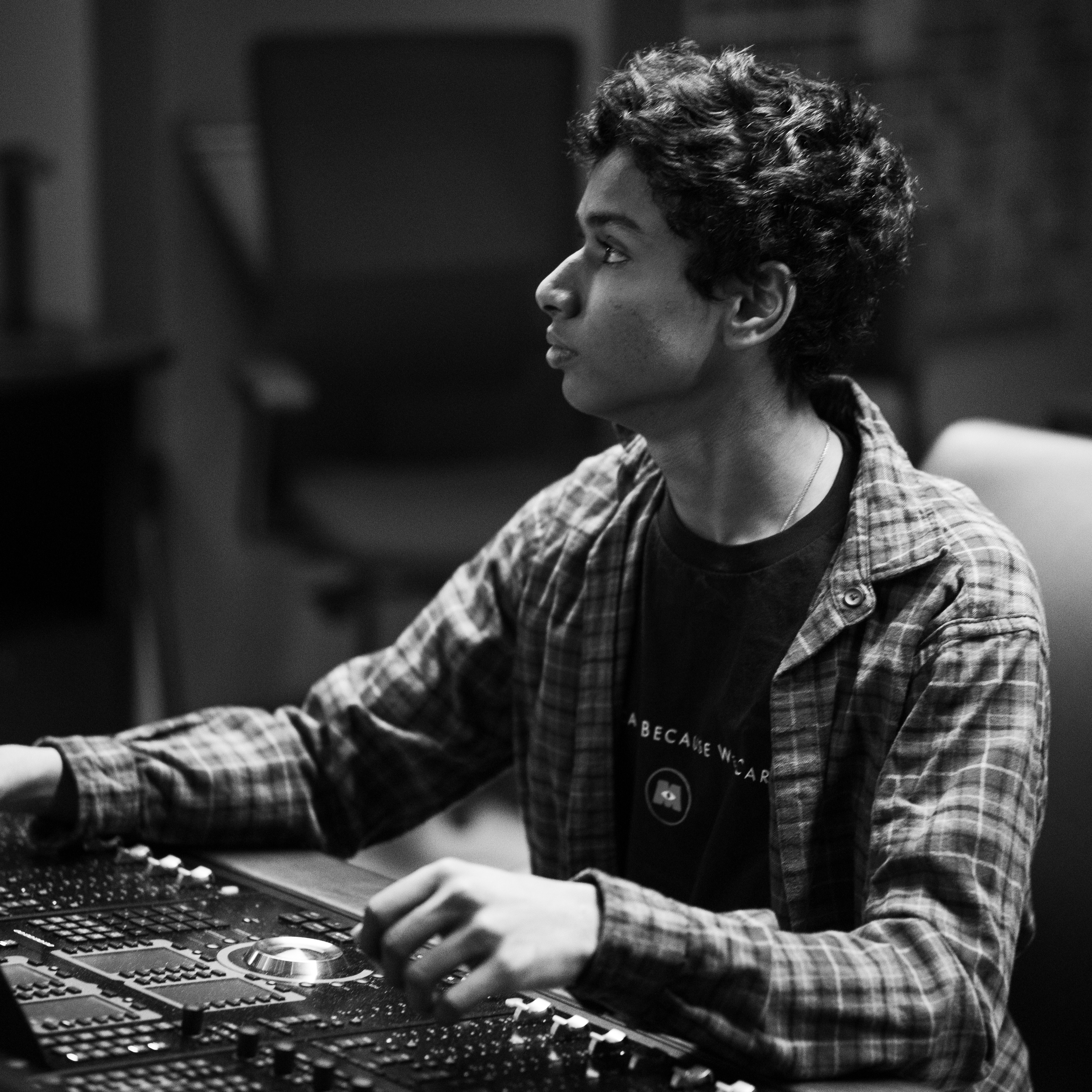
In the multibillion-dollar world of AAA video games, the visual drama of a game often grabs the headlines. However, the true soul of a gaming experience — the element that triggers a player’s fight-or-flight response, brings a tear to their eye, or makes a digital world feel tangible — lies in the audio. Audio engineers and music designers are the invisible architects of these emotional landscapes, wielding the power to ground players in hyper-realistic environments through spatial 3D audio and dynamic musical scores.
As part of this sonic revolution is Udit Srivathsan, a music designer and audio engineer whose fingerprints are across some of the most anticipated titles in the industry. Currently serving as a Music Designer at Sony Interactive Entertainment America, Srivathsan is preparing for a massive year. With the highly anticipated Ghost of Yōtei: Legends slated for release on March 10, and work continuing on heavy hitters like Marvel’s Wolverine, Srivathsan is redefining what it means to bridge the gap between technical engineering and creative composition.
Srivathsan’s path to the upper echelons of PlayStation’s audio team began not in a coding lab, but in the halls of the San Francisco Conservatory of Music. For the past five years, he has honed a craft that requires equal parts mathematical precision and musical intuition.
“I started as a student recording engineer recording recitals, student recording sessions for classical music, and studio recordings for the jazz program,” Srivathsan recalls. This foundation in traditional genres — soloists, chamber ensembles, and full orchestras — provided him with an “ear” for acoustic authenticity that is often missing in purely digital productions. Internships under industry veterans like Matt Levine, Daria Novo, and Dren McDonald further sharpened his ability to handle complex sessions.
This diverse background has allowed Srivathsan to navigate disparate genres with ease. From leading sessions for the eclectic avant-garde group The Residents on their Dr. Dark album to working on the Meta Sound Collection, he has learned to adapt to the “vibe” of any project. “The Dr. Dark album was certainly a strange one,” he says. “I’d led sessions recording brass and strings over a super eclectic sounding band, which was a challenge because I had no idea what kind of sound this group wanted. It forces you to grow as a musician.”
One of the most misunderstood aspects of game development is the distinction between music engineering and music design. Srivathsan occupies a hybrid space that allows him to see a project from the first note recorded to the moment it reacts to a player’s input.
“Music engineering involves preparing the score for recording sessions — creating a ‘map’ of what and how to record,” Srivathsan explains. This technical phase is about flexibility. By ensuring that high strings, low strings, melodies, and accompaniments are recorded and mixed into separate “stems,” engineers provide the raw materials that can later be manipulated.
Music designing, however, is where the “magic” happens. “It’s the next step where we take those mixed stems and re-arrange and re-compose the music for specific contexts in-game,” he says. Because he functions in both roles at Sony, Srivathsan brings a unique foresight to the table. “Deciding to split the high and low strings early on means that down the line, editors have the live material separate to edit freely. Being a music designer has given me this foresight which has definitely proven useful.”
This meticulous approach has not gone unnoticed. Srivathsan’s work on Ghost of Yōtei has already earned a 2026 MPSE Golden Reel Award nomination for Outstanding Achievement in Music Editing, a testament to the technical complexity of the project.
While the gaming community is buzzing about the shift to a new protagonist and time period in the Ghost franchise, the upcoming release of Ghost of Yōtei: Legends on March 10 is set to be a landmark moment for multiplayer audio. Srivathsan, who was a key part of the engineering team for the project, helped craft a soundscape that supports a deep, class-based combat system.
In Legends, players can choose from four distinct classes: the Samurai, Archer, Mercenary, or Shinobi. Each class requires a unique sonic identity. The Samurai, wielding the massive ōdachi, requires audio that emphasizes weight and power. The Archer, utilizing the yari (spear) and ranged weaponry, needs a cleaner, more precision-focused audio palette. Meanwhile, the dual-katana-wielding Mercenary and the stealthy, kusarigama-using Shinobi demand soundscapes that highlight agility and environmental awareness.
The gameplay in Legends is as ambitious as its audio. Launching with three mission types — Survival, Story, and Incursions — the game introduces a system of “Curses” and “Blessings.” In Survival mode, players fight to control territory across four maps; losing control unleashes a Curse that puts the team at a disadvantage, while holding a point grants a Blessing.
Ghost of Yōtei is only one piece of Srivathsan’s current workload. He is also contributing to Marvel’s Wolverine, a title that is perhaps the most anticipated superhero game in development. His credits extend to Kena: Scars of Kosmora, Marvel Tokon: Fighting Souls, and Saros, as well as high-profile titles like Helldivers 2 and MLB The Show 2026.
As a music designer on these projects, Srivathsan is tasked with ensuring that the music feels reactive. In a game like Marvel’s Wolverine, the music must transition seamlessly from the tension of stealth to the visceral, high-octane violence of combat. This requires a level of “technical listening” that most people never realize is happening.
“People don’t really get to see what happens on the engineering side,” Srivathsan says. “When composers send over their content, while it sounds amazing compositionally, it’s really a mix engineer’s job to deliver it to your ears in the best way possible. That means ensuring the right balance, fixing imperfections, and conducting the listener’s attention to where it needs to be.”
As the industry evolves, Srivathsan is also looking at how technology like Artificial Intelligence will change the workflow. Unlike those who fear AI might replace the composer, Srivathsan sees it as a tool for the “manual labor” of audio engineering.
“While I don’t believe that AI mixing and mastering is quite there yet, there’s certainly room for improving the workflow and grunt work through AI tools,” he notes. Though not AI-driven, he points to existing systems like Soundflow that automate time-consuming tasks, allowing engineers to focus on the “musically involved” aspects of the job.
Beyond AI, Srivathsan is a champion of immersive formats. His work as an Upmix Engineer for the Masterminds II Music Kit Box — working in Dolby Atmos with legendary composers like Austin Wintory — shows his commitment to the 3D audio space. For Srivathsan, the goal is always the same: to blur the line between the player and the game world.
Whether it is the haunting melodies of a supernatural boss fight in Ghost of Yōtei: Legends or the grit of a Marvel action sequence, Udit Srivathsan’s work ensures that when players pick up a controller, they aren’t just playing a game — they are hearing a living, breathing world. As Legends prepares for its March 10 debut, players would be wise to turn up the volume; they are about to hear the work of one of the industry’s most talented rising stars.
For more information, visit the official website.