Autonomous vehicles have crossed an important threshold. They are no longer just research programs, controlled pilots, or speculative promises. They are operating on public roads, carrying passengers, and expanding from a handful of launch markets into broader commercial networks.
That progress matters. For years, the defining question was whether a vehicle could drive safely without a human behind the wheel. That question has not disappeared, and it would be naive to pretend the technology is finished. But the industry has now learned enough from real-world deployment to expose a second bottleneck: what happens around the vehicle when it is not carrying a passenger.
The next phase of autonomy will be decided less by the headline capability of the driving system and more by the operating system around the fleet. Can the vehicle stay in service? Can it charge without losing half its useful shift? Can its sensors remain clean? Can it be inspected, reset, and returned to demand quickly enough for the economics to work?
Vehicles Do Not Just Drive. They Reset.
From the outside, a robotaxi experience can look almost magical. A car arrives, the rider gets in, the vehicle completes the trip, and the car moves on. But a commercial fleet is not a collection of isolated rides. It is a continuous industrial operation spread across a city.
Every vehicle has to cycle through a set of physical tasks. It needs energy. It needs interior and exterior cleaning. Its cameras, lidar, radar, and other sensing surfaces have to remain clear. It needs inspections, diagnostics, data handling, consumables, and in some cases calibration or light intervention before it can confidently return to service.
This is the hidden reset layer of autonomy. It is not glamorous, but it is where the theoretical promise of continuous operation either becomes real or breaks down. A vehicle that can drive itself but spends large parts of the day traveling empty, waiting in a queue, or sitting offline inside a depot is not yet operating like a software network. It is operating like a logistics business with expensive hardware trapped inside it.
The Depot Model Is Necessary – But Not Sufficient
The industry has naturally inherited a depot-centric model. That makes sense. Fleets need secure facilities for storage, heavy maintenance, deeper diagnostics, repairs, staging, and end-of-day operations. Depots will remain part of the system.
The problem is that depots are a poor answer to every high-frequency task. If a vehicle has to leave its operating zone, travel across a city, wait for charging or service, receive manual support, and then return to demand, the fleet has built a hidden tax into every operating day. The tax shows up as empty miles, offline time, lower revenue hours, more vehicles required to serve the same demand, and more complexity in dispatch and routing.
Centralized depots also fight against the geometry of dense cities. The land that is close to demand is scarce and expensive. The land that is cheap enough for large facilities is often far from where the vehicles need to earn money. That tradeoff is manageable at small scale. It becomes punishing when the fleet grows.
The Economics of Autonomy Are a Utilization Game
The economic promise of autonomous vehicles has always depended on utilization. Removing the human driver changes the cost structure, but it does not magically create a profitable network. The vehicle itself is expensive. The sensing stack is expensive. Insurance, maintenance, cleaning, charging, fleet supervision, real estate, and city operations all still matter.
The business only works if each asset spends more of its life generating revenue and less of its life repositioning, queueing, and waiting. Every empty mile is not just a routing inefficiency. It is foregone revenue, added energy cost, added wear, added congestion, and added operational complexity. Every offline minute compounds the same problem.
This is why infrastructure matters so much. Autonomy changes who drives the vehicle. Infrastructure changes how many productive hours the vehicle can deliver. In a scaled robotaxi business, that distinction is decisive. The operators with the best fleet availability, fastest reset cycles, and lowest operational friction will have a structural advantage.
The Reset Layer Will Move Closer to Demand
This pattern is not unique to autonomous vehicles. Networks usually begin with centralized infrastructure and then become more distributed as demand density, latency requirements, and utilization pressure increase. Telecom networks needed towers, fiber, and small cells. Cloud computing moved from centralized data centers toward edge infrastructure for certain workloads. Electric vehicles became more practical as charging moved closer to where drivers actually lived, worked, and traveled.
Autonomous vehicles are entering the same phase. The industry will still need large depots, but it will also need a denser layer of smaller, more distributed operating points positioned close to where vehicles spend their working day. These sites do not need to do everything a depot does. They need to handle the repeatable, high-frequency reset tasks that determine whether a vehicle remains available.
Underutilized parking lots, commercial real estate, roadside footprints, fleet yards, and DC fast-charging locations can become part of this layer. Some sites will operate as single nodes. Others will become clusters or satellites. The important shift is not the label. It is the movement of operational capacity from the edge of the city into the operating zone itself.
Infrastructure Has to Become a Product
The hard part is not simply placing equipment on real estate. The hard part is turning a messy operational workflow into a repeatable product. Charging, cleaning, inspection, sensing, data, dispatch, safety, permitting, power, water, waste, fleet integration, and local site constraints all have to work together.
That is why the next infrastructure layer for autonomy cannot be treated as a collection of one-off facilities. It has to be designed like a product and deployed like a network. The hardware has to be modular. The software has to integrate with fleet operations. The site model has to fit the constraints of real cities. The economics have to work for operators, property owners, charging networks, and the companies deploying the infrastructure.
The goal is not to create another bespoke depot for every market. The goal is to make the reset cycle predictable, repeatable, and close enough to demand that the vehicle can move from revenue service to readiness and back again in minutes, not hours.
Why We Built Aseon Labs
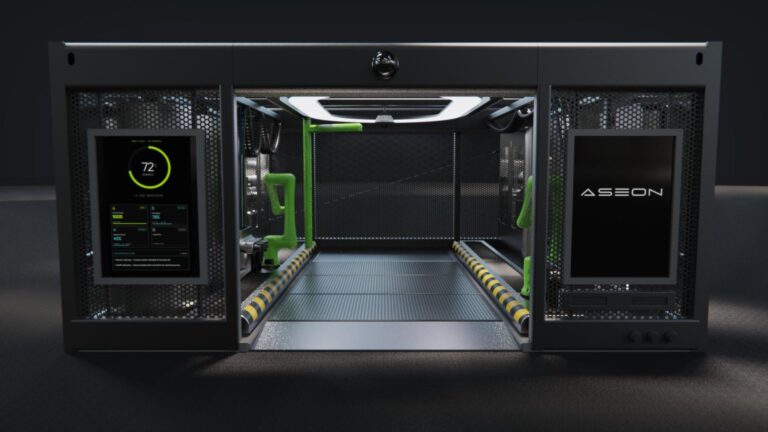
This is the problem we are building for at Aseon Labs. We are developing robotic pitstops for autonomous vehicle fleets: modular micro-depots that bring charging, cleaning, inspection, and reset operations closer to where vehicles actually operate.
We do not see this as a robot in a box. We see it as operating infrastructure for autonomy. The product sits at the intersection of hardware, software, fleet operations, real estate, and urban deployment. It has to fit into existing sites, work with existing charging and service infrastructure where possible, and help operators reduce the dead time between trips.
In our view, the winning model will not replace every depot. It will separate the work. Heavy maintenance, storage, and complex intervention can remain centralized. The high-frequency reset cycle should move into distributed nodes and satellites inside operating zones. That is how autonomous fleets become more available without requiring every city to build a new generation of large urban depots.
The lesson comes from experience. Before Aseon, Dan Keene and I helped build and scale physical infrastructure for shared mobility. Battery swapping for micromobility only became valuable when the network was dense, reliable, and close to the vehicles that depended on it. Autonomous fleets are a different market, but the underlying infrastructure lesson is similar: the asset is only as productive as the system around it.
The Companies That Will Define the Next Phase
The first chapter of the autonomous vehicle industry was about proving the driver. The next chapter will be about proving the operating model. That means the industry will need new metrics, not just miles driven or disengagement rates. It will need to care about reset time, revenue hours per vehicle, empty-mile reduction, site density, energy availability, cleaning throughput, inspection consistency, and the cost of keeping each asset ready for its next trip.
The companies that define the next phase of autonomy will not necessarily be only the companies with the most advanced driving models. They will be the companies that can turn autonomous vehicles into reliable, continuously operating fleets. That requires infrastructure that is close to demand, economically rational, and embedded into the physical constraints of cities.
In other words, the industry is moving from an autonomy problem to a systems problem. The vehicle is one part of that system. The city, the site, the charger, the cleaning process, the inspection workflow, the dispatch logic, and the reset cycle are all part of it too.
The Infrastructure That Disappears Wins
The best infrastructure eventually disappears into the background. Riders do not think about cellular towers when a map loads. Drivers do not think about grid interconnections when they plug into a charging network. Users experience the outcome, not the machinery behind it.
That will be true for autonomous vehicles as well. When robotaxis feel truly seamless, it will not be only because the driving system improved. It will be because the surrounding physical infrastructure finally caught up. Vehicles will be cleaner, more available, closer to demand, and less dependent on long trips back to centralized facilities for routine work.
At that point, autonomy will not just scale. It will compound. The network will get better as infrastructure density improves, as reset cycles shorten, as each asset generates more productive hours, and as cities learn how to support autonomous fleets without forcing them into yesterday’s operating model.
The question is no longer whether autonomous vehicles can drive. It is whether they can operate continuously, efficiently, and profitably inside the constraints of real cities. The answer will determine who actually wins the autonomy era.