
Many inventions begin with a simple observation. Someone encounters a recurring inconvenience, sees room for improvement, and starts thinking about how a product could solve the problem more effectively.
That pattern can be found across many types of consumer products, from kitchen accessories to recreational gear and wearable technology. Inventions such as MixAid, Stack ’Em, and Intellinetix offer three examples of how practical ideas can develop from everyday experiences.
They also reflect a broader part of the invention economy, where independent creators often work outside traditional corporate research and development teams. Some eventually seek assistance from invention service companies, licensing specialists, patent professionals, manufacturers, or retailers as they move from an idea toward a marketable product.
MixAid and a Familiar Kitchen Problem
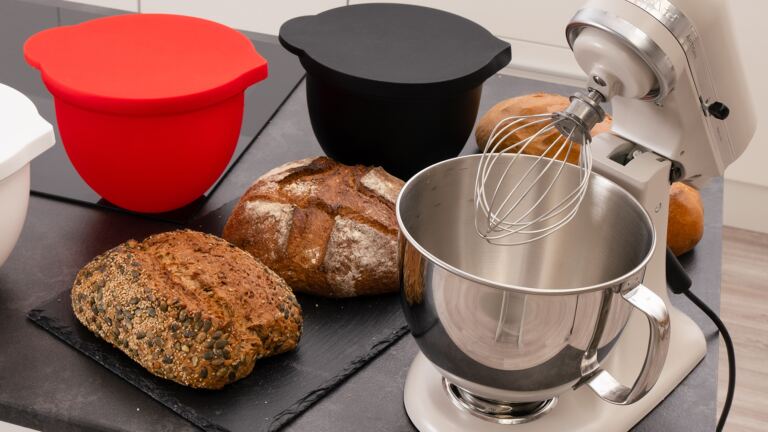
MixAid was developed by inventors Luisa Marchese and Dawn Archie-Johansen of Tyler, Texas. According to accounts of the product’s development, their idea came from a common issue faced by people who use stand mixers for multiple recipes: repeatedly stopping to wash and reuse the same mixing bowl.
The product is a reusable insert designed to fit inside a stand mixer bowl. It allows ingredients to be mixed, poured, and stored without requiring the primary bowl to be cleaned between every preparation.
The concept is straightforward. Rather than creating an entirely new kitchen appliance, the inventors focused on improving one step in an existing process.
The inventors later worked with InventHelp’s submission services, and MixAid was licensed by MBDB Products LLC. The product was displayed at The Inspired Home Show in Chicago and later became available through ecommerce and international retail channels.
According to a January 2026 announcement, MixAid sold out on Amazon within three days, generated nearly $100,000 in sales during that period, and reached the top position in its category. Its development provides one example of how an idea based on convenience can evolve into a commercially available consumer product.
Stack ’Em and Recreational Convenience
Stack ’Em originated from another ordinary situation.
Inventor Andy Beier of Duluth, Minnesota, has said the idea emerged while spending time on the water and looking for a more convenient way to keep an additional beverage nearby.
The resulting product is an insulated beverage holder capable of holding two cans while maintaining a size suitable for standard cup holders. It uses a spring-loaded design and double-wall construction and has since been produced in multiple sizes and colors.
Beier later worked with InventHelp and its licensing division, Intromark. According to Stack ’Em, they generated more than $147,000 in sales between July and September 2025 and became available through retailers and ecommerce platforms including Scheels and Amazon.
In 2026, Stack ’Em was selected for the International Housewares Association New Product Showcase and Global Innovation Awards program associated with The Inspired Home Show.
The product illustrates a recurring feature of consumer-product development: an idea does not necessarily need to address a large or complex problem. Products can gain attention simply by making a specific activity easier or more convenient.
Intellinetix and Wearable Technology
Intellinetix developed from a different kind of personal experience.
Inventor Lestor Waldon, a retired letter carrier from Orlando, Florida, became interested in wearable vibration technology after years of walking postal routes and experiencing joint discomfort.
His early concept eventually became the Intellinetix Knee and Elbow Wrap. The product line later expanded to include wearable devices designed for different areas of the body, including the back, knee, wrist, ankle, and calf.
The products combine compression and vibration, while some models also incorporate heat. The broader Intellinetix line has included rechargeable wearable wellness products intended for home and everyday use.
Waldon received patent-related assistance through an independent patent professional referred through InventHelp, while Intromark later helped facilitate a licensing agreement with Brownmed. Intellinetix products subsequently became available through retailers and ecommerce platforms including Walmart, Walgreens, CVS, Best Buy, and Amazon.
The story offers another example of how personal experience can help an inventor identify a need that may also be shared by a larger group of consumers.
The Role of Independent Inventors
MixAid, Stack ’Em, and Intellinetix are very different products, yet their origins share a common theme. Each began with someone noticing something in everyday life that could potentially be improved.
Independent inventors often start without the product-development resources available to larger companies. Moving forward may involve preparing drawings, creating prototypes, researching intellectual property, evaluating manufacturing options, or presenting an idea to potential licensees.
Companies such as InventHelp operate within that broader ecosystem by providing invention-related services and helping clients prepare and submit ideas. Robert Susa, who has worked with InventHelp since 1990 and now serves as its President and Owner, has spent much of his career around that process and the challenges involved in taking an idea beyond its earliest stage.
As with any effort to commercialize a new product, outcomes can vary, and licensing, retail placement, or sales are not assured.
The larger takeaway is not limited to any one company or product. Consumer innovation frequently begins with close observation. A person notices an inconvenience, questions an existing process, and develops an alternative.
Whether the result is a kitchen accessory, an outdoor product, or a piece of wearable technology, many inventions start in much the same way: with an ordinary problem and someone willing to look at it differently.