
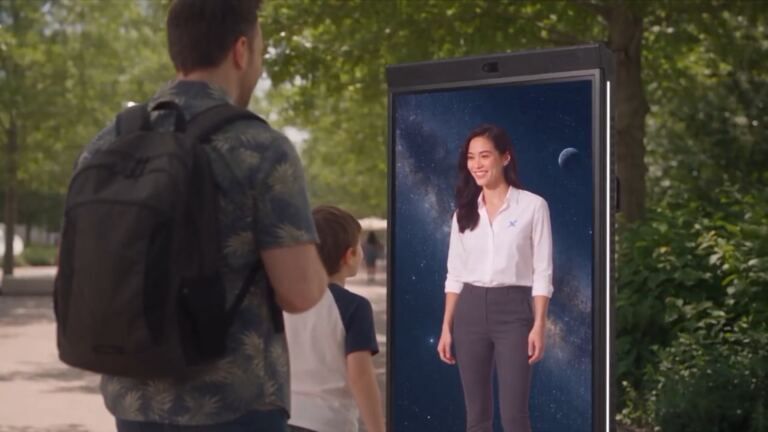
Powered by NVIDIA technology, LiveX’s human-like AI Hosts are bringing conversational assistance, personalized recommendations, and multilingual guidance to airports, hospitals, stores, and public venues.
Imagine arriving at an unfamiliar airport and being able to ask where your gate is, whether there’s somewhere nearby to eat, and how long it will take to get there. Now imagine getting a natural answer in your own language, without downloading an app, scanning a QR code, or navigating a maze of touchscreen menus.
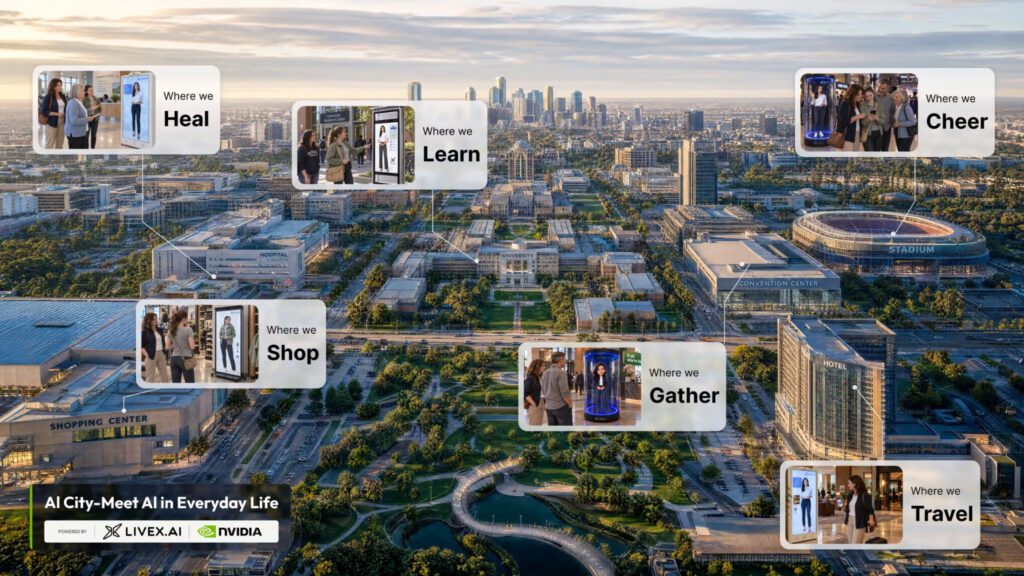
That’s the kind of interaction LiveX wants to make possible. At the Smart City Expo World Congress in Barcelona on November 3, the company unveiled AI City, a platform designed to bring conversational AI directly into physical spaces. Developed with NVIDIA technologies, it uses life-size, human-like AI Hosts to help people find their way, discover products, and get information in airports, hospitals, hotels, retail stores, and entertainment venues.
The premise is simple. Instead of asking people to go looking for AI, put it where they already are.
The World Doesn’t Need Another Touchscreen
We’ve become used to interactive screens in public places. Airports have information kiosks, shopping centers have digital directories, and hospitals have check-in systems. They can be useful, but they generally expect visitors to know what they’re looking for and how to find it in a fixed menu.
That isn’t always how people ask for help. A first-time hospital visitor may not know the name of the department they need. A shopper might have a product in mind but want a recommendation. A traveler may simply need directions in a language they’re more comfortable speaking.
LiveX’s AI Hosts are designed for those less scripted exchanges. Visitors can approach and speak naturally, receiving conversational responses, personalized recommendations, and location-aware guidance. The platform is already deployed at more than 100 customer sites, including PUMA stores, San José Mineta International Airport, SAP Center, the San Jose Sharks stadium, El Camino Hospital, and Marriott and Hilton hotels.
Those settings have little in common on the surface. What they share is a steady flow of people who need information or assistance, while staff can’t always be available to answer every question.
LiveX cofounder, President and Chief AI Officer Jia Li sees that as an opportunity to make AI useful in the places where everyday life happens.
“We believe intelligence of this nature should meet people wherever they are, live and in person, where life happens,” Li said. She imagines AI greeting travelers, guiding hospital visitors, helping shoppers and answering questions from tens of thousands of fans.
Giving AI a Sense of Place
AI City is more than a talking information desk. Its expanded capabilities include interactive 3D maps for navigation and discovery, 3D product recommendations, and multilingual translation. The goal is to help an AI Host understand not only what someone is asking, but also the physical setting in which the question comes up.
The platform’s new Physical AI Host experience is powered by Lyra, short for LiveX Your Real-world AI Agent. Lyra coordinates capabilities including multimodal understanding, visual generation and noise management, allowing the Host to respond through speech, expression and movement. Noise management is especially relevant in airports, stadiums and busy retail floors, where conversations have to compete with the surrounding environment.
LiveX has developed proprietary models shaped by real-world interaction data from its deployments. The aim is to build for the messy conditions of public spaces, not just the quiet back-and-forth of a chatbot window.
NVIDIA Helps Power the Experience
The partnership with NVIDIA provides the computing infrastructure and AI technologies behind the platform. LiveX runs on NVIDIA RTX PRO 6000 Blackwell Server Edition GPUs and uses the NVIDIA Metropolis VSS Blueprint to build visual AI agents. Its technology stack also incorporates NVIDIA Cosmos open-world models and a fine-tuned Nemotron model. NVIDIA retrieval and reranking tools help surface relevant information, while Omniverse libraries can be used to build digital twins for location-aware applications.
Madison Huang, Senior Director of Product and Technical Marketing for Physical AI Platforms at NVIDIA, said AI that understands people and their surroundings can make everyday spaces more helpful and accessible. The collaboration is focused on helping people navigate, explore products, and get assistance through natural, multilingual conversation.
The first LiveX Physical AI Host debuted at NVIDIA GTC 2026, where attendees could approach and interact with it hands-free in the language of their choice, even amid conference noise.
The Most Useful AI Might Be the Kind You Don’t Have to Look For
AI progress is often measured through increasingly impressive demonstrations, more capable models, more sophisticated robots and systems that can perform tasks that once seemed impossible. But some of its most useful applications may be less dramatic.
It could be an assistant helping an older visitor find the right hospital department, a Host making an unfamiliar store easier to navigate, or a system answering questions from a crowd of sports fans. Those aren’t futuristic problems. They’re ordinary moments when a little timely help can make a place easier to use.
There are still practical questions as these systems expand, including how they perform at scale and how organizations fit them into existing operations. But LiveX already has deployments across more than 100 sites, giving it a real-world base from which to develop the idea.
The ambition behind AI City is to make intelligence available as naturally as asking another person for help. That doesn’t require every public space to fill up with walking, talking robots. Sometimes the more useful innovation is simply having someone to ask when you don’t know where to go.