
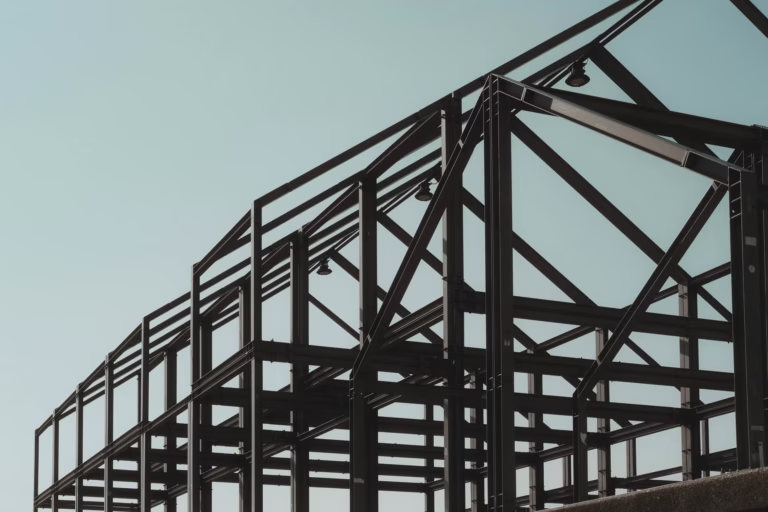
Lackawanna College is reshaping its physical footprint and academic priorities around workforce demand for advanced manufacturing, robotics, and cybersecurity skills. Construction of The Lackawanna College Center for Technology Innovation is underway in downtown Scranton, with steel framing and block walls rising on a formerly vacant lot at 518-520 Wyoming Avenue. The $10 million project signals a broader institutional shift toward hands-on technical training at a moment when corporate demand for specialized AI, automation, and engineering talent is outpacing traditional degree supply.
The college’s bet on applied Technology reflects a regional and national pivot. While higher education still emphasizes liberal arts and general credentials, employers in energy, manufacturing, and financial services are hunting for graduates who can operate in robotics labs, manage cybersecurity systems, and troubleshoot electric vehicle platforms. Institutions that can build physical infrastructure and recruiting pipelines around those skills are positioning themselves as critical supply lines for a workforce gap that institutional capital and government funding now take seriously.
From Renovation Failure to New Construction
Lackawanna College originally planned to house its technology programs inside a six-story building at 401 Adams Avenue, constructed in 1973. The renovation estimate proved prohibitive, and the college pivoted to new construction on a smaller, vacant downtown site. That decision forced the college to list the Adams Avenue property for sale in 2024, a move that illustrates how facility constraints can reset institutional strategy faster than traditional deliberation allows.
The new center comprises a 17,000-square-foot two-story building and a 6,500-square-foot former Able Brake facility next door. Inside, the college will house robotics, electric vehicle, advanced vehicle, and cybersecurity programs. The space includes automotive lifts, electric vehicle charging and diagnostic equipment, robotics and automation labs, and dedicated computer labs for cybersecurity coursework. The college aims to open the center during the fall 2026 semester, though initial summer 2026 completion expectations have shifted as construction moves into later phases.
Public Dollars, Corporate Investment, Tax Incentives
The college assembled funding through a mix of government grants and corporate donations. Coterra Energy contributed $1 million and received $750,000 in state tax credits through the Department of Community and Economic Development’s Neighborhood Assistance Program. The Appalachian Regional Commission’s Area Development Program awarded $1 million, the largest amount the program has granted to a single project. That layering of federal, state, and corporate capital reflects how regional development agencies now view workforce readiness as critical infrastructure.
The center will offer undergraduate degrees, corporate training certificates, and dual-enrollment courses for high school students. That model addresses both immediate skill gaps and pipeline concerns. A high school student can earn credentials while still enrolled, and working professionals can access retraining without committing to a full degree cycle.
Why This Moment Matters for Regional Institutions
Regional colleges have historically competed on location, affordability, and convenience. As remote work and online degree pathways dissolve that advantage, institutions that cannot offer hands-on equipment and facilities aligned with employer demand are losing enrollees to competitors and to workforce pipelines offered directly by employers. A college with a robotics lab and electric vehicle bays has a tangible recruiting advantage over one with only lecture halls and seminar rooms.
Lackawanna’s timing also aligns with accelerating corporate investment in responsible AI and governance frameworks. At a national level, enterprise consulting firms like Capco have won recognition from OpenAI for delivering AI governance and risk management solutions in regulated industries. That demand upstream signals downstream hiring pressure for graduates who understand both technical systems and compliance requirements. Cybersecurity and automation training that includes governance and risk concepts is more valuable to employers than isolated technical training.
Questions About Completion and Enrollment Uptake
The college has not confirmed whether the building will be ready by fall semester start, though Vice President Brian Costanzo stated the goal is a fall opening. Construction timelines for downtown infill projects often shift. If completion extends into early 2027, the college may lose momentum in fall recruiting and see freshman cohorts smaller than projected.
Enrollment uptake is another open variable. The center’s success depends on whether regional students and working adults perceive the programs as credible pathways to employment. If local employers actively recruit from the programs and offer salary premiums to graduates, word-of-mouth and employer referrals will sustain demand. If employers treat the credentials as generic or uncertain, enrollment may plateau.
Lackawanna College’s technology center bet represents a reasoned institutional response to specific labor market pressures. It does not guarantee regional economic transformation. But it does signal that education leaders in industrial regions now understand that facility-based, applied technical training is no longer optional for institutional survival. The center’s completion timeline and its first cohort’s employment outcomes will indicate whether this model is replicable for other mid-sized regional colleges facing similar competitive and demographic pressures.