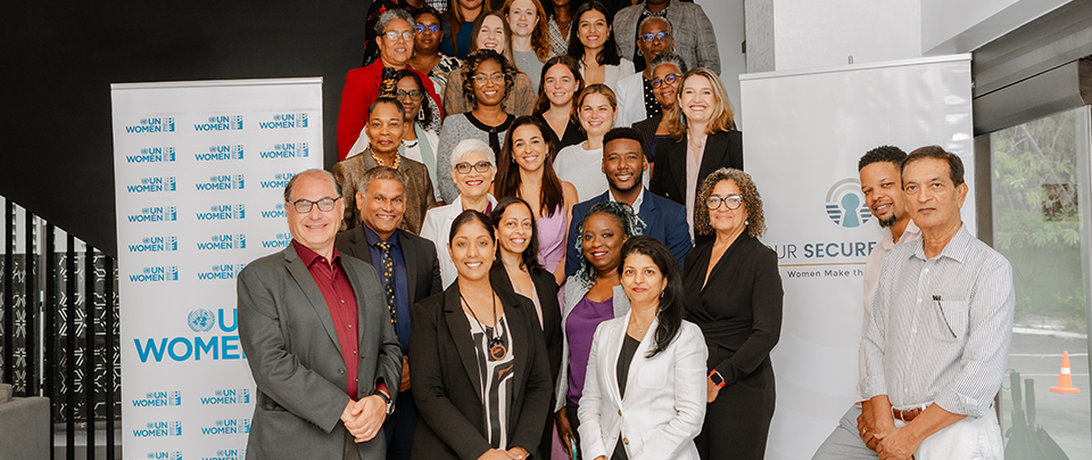
For decades, women leaders, civil society organizations, and regional advocates across the Caribbean have worked to advance peace and security, with efforts grounded in addressing challenges such as organized crime, disaster response, and community resilience. These initiatives have been shaped by local priorities and regional policy traditions, and have long centered on women’s leadership, community participation, and inclusive approaches to security. These reflect and reinforce shared principles central to the Women, Peace and Security agenda around participation, protection, and comprehensive approaches to peace and security governance. These sustained efforts laid the groundwork for deeper regional engagement on WPS, including the formal adoption of National Action Plans (NAPs). Our Secure Future’s Women, Peace and Security (WPS) NAP Academy emerged within this context as a platform designed to build on, elevate, and connect existing local leadership and advocacy.
Building on earlier regional and global learning efforts, Our Secure Future (OSF), in partnership with UN Women, supported the Caribbean WPS NAP Academy as a space to consolidate lessons learned and strengthen locally driven policy processes. Their joint policy brief, “Advancing Women, Peace and Security: Lessons Learned from the Caribbean,” traces how this initiative helped amplify long-standing regional work while supporting governments and civil society to build and translate political will into formal policy frameworks. Implemented by OSF with UN Women, the WPS NAP Academy functioned as both a training ground and a catalyst, equipping participants with practical tools to design and implement WPS National Action Plans grounded in regional realities and local ownership.
The 2024 convening in Trinidad and Tobago, attended by representatives from Barbados, Guyana, Jamaica, and Trinidad and Tobago, marked a significant milestone in this ongoing journey. Within a year, Trinidad and Tobago launched the Caribbean’s first-ever WPS NAP, reflecting the cumulative impact of years of local advocacy strengthened through regional collaboration.
This brief highlights the role of the WPS NAP Academy as a catalyst for collective action. Its lessons offer a guide to governments, activists, and institutions working to translate global commitments into meaningful local action.
Building the Foundations of Peace
Since the adoption of UN Security Council Resolution 1325 in 2000, the WPS agenda has expanded beyond war zones to include security issues related to organized crime and climate disaster relief efforts. Across the Caribbean, women’s rights organizations, community leaders, and civil society advocates have long engaged with these issues, advancing locally driven approaches to peace, security, and resilience despite limited formal policy frameworks. Yet, even as fourteen countries across the Americas have adopted a WPS NAP, the Caribbean region still lacked one as of 2024. The Trinidad and Tobago WPS NAP Academy built on this history of regional advocacy and collaboration, helping to translate years of local WPS engagement into a formal National Action Plan process.
The WPS NAP Academy convened senior officials from the ministries of security, social development, and foreign affairs alongside civil society leaders and CARICOM representatives. Their task was to create a shared framework where women’s meaningful leadership became inseparable from peace and security policy.
By embedding the process within regional structures like CARICOM, OSF, and UN Women worked to ensure that lessons extended beyond a single country, laying the groundwork for a Caribbean-wide discourse on women’s participation in peace efforts.
From Momentum to Milestone
The policy brief chronicles efforts by OSF and UN Women to translate momentum into tangible policy through the WPS NAP Academy. The process revealed key lessons, the first of which was that inclusivity mattered as much as technical expertise. The first advisory group on NAP development in Trinidad and Tobago excluded civil society, limiting early input, but later sessions, particularly during the WPS NAP Academy, corrected that gap. The workshops delivered practical tools for coordination, budgeting, and results-based management, helping participants turn broad commitments into concrete steps. Within months, Trinidad and Tobago refined its draft plan and, in March 2025, launched the Caribbean’s first official WPS National Action Plan.
Regional Ripples and Shared Lessons
Following the 2024 WPS NAP Academy convening in Trinidad and Tobago, CARICOM began exploring a regional WPS framework and proposed appointing a Caribbean WPS Envoy to promote coordination and advocacy. This regional momentum underscored how shared learning can lead to shared action, especially when tackling transnational challenges like organized crime, climate change, and human trafficking.
Still, the brief emphasizes that progress depends on communication and continuity. Limited early outreach in Trinidad and Tobago, due to national elections, delayed public awareness. Future NAPs, the authors recommend, should integrate communications and visibility from the outset to strengthen accountability.
Another key takeaway was the need to embed costing and operational planning early. While Trinidad and Tobago’s NAP outlined clear priorities, its tight timeline left little room for detailed budgeting before launch. Later implementation workshops filled some of those gaps, but the experience showed that sustainability begins with financial planning.
A Shared Vision for Peace
For Our Secure Future, this collaboration aligns with its mission to strengthen the Women, Peace and Security agenda by amplifying women’s voices, enhancing inclusive governance, and turning policy into practice to prevent predictable global crises and build more sustainable peace.
The co-published brief is more than documentation; it is a roadmap. It demonstrates that inclusive policymaking, political commitment, and sustained technical support can turn principles into practice. The WPS NAP Academy model now serves as a template for other nations ready to define their own paths in advancing Women, Peace and Security.
The launch of a WPS NAP marks the beginning of a transformative journey for the Caribbean. By placing women’s leadership at the center of peace and security efforts, the region is redefining who shapes policy and whose voices guide decision-making. The WPS NAP Academy has shown that when governments, civil society, and regional institutions work together, it is possible to turn commitments into concrete action and set new standards for collaboration.