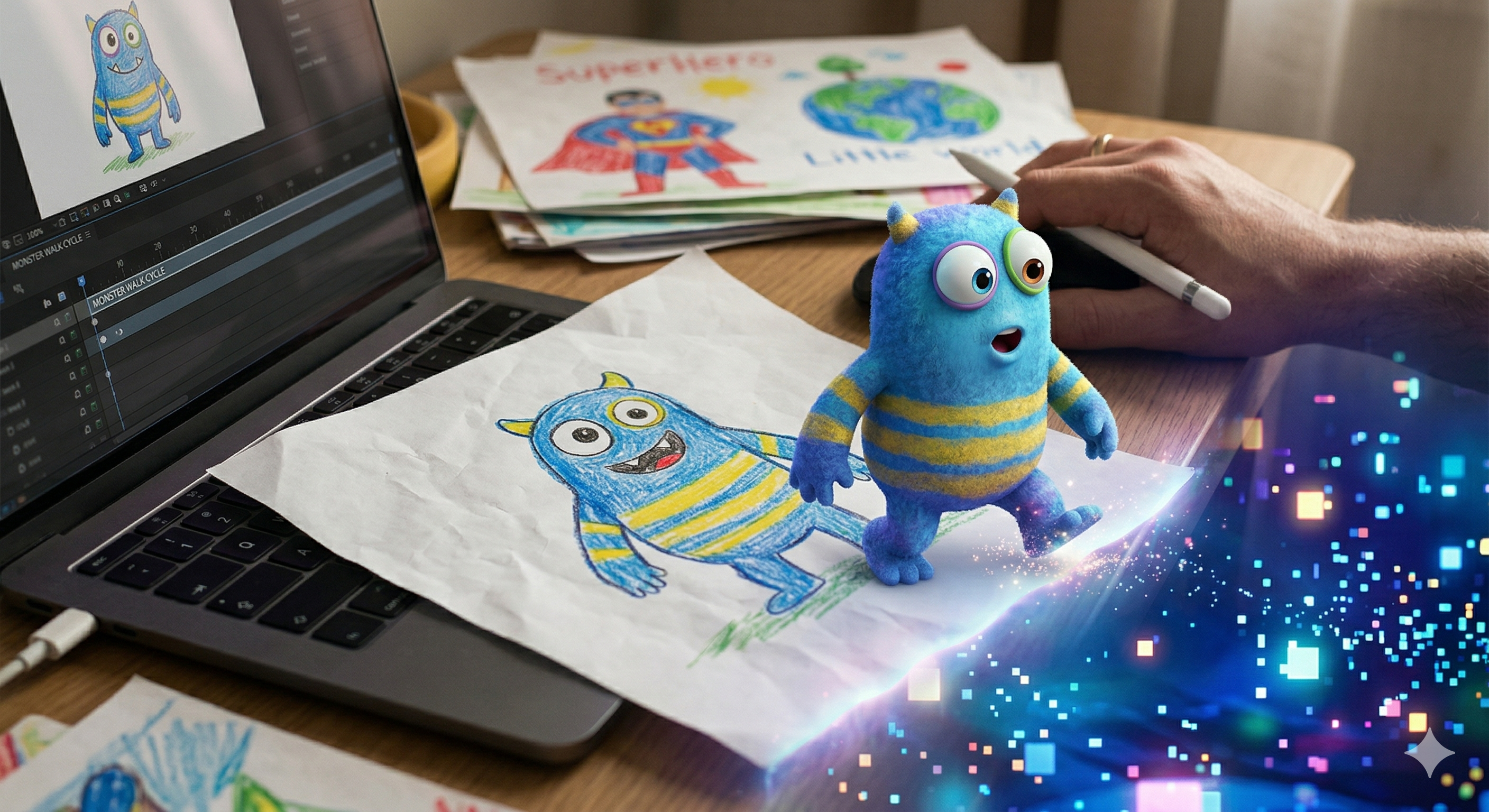
A parent sits with a stack of drawings. Monsters, superheroes, little worlds – the kind only a kid can dream up. For most of us, those drawings live on the fridge or in a memory box. But this parent had a different idea, driven by a gut-wrenching reality: their young son is seriously ill. And in that quiet moment, looking at crayon-smudged paper, they realized something profound: “I can actually make these move.”
This isn’t some corporate case study about efficiency or optimization. This is a story that hit the internet like a tidal wave because it’s deeply, unequivocally human.
The Unspoken Promise of Imagination
Imagine being able to take a child’s wildest dreams, sketched hastily on paper, and transform them into living, breathing scenes. That’s exactly what happened. This parent, using a handful of AI image and video tools, didn’t just digitize drawings. They:
- Enhanced the original sketches, cleaning up lines and adding detail.
- Generated rich, imaginative backgrounds and scenes that matched the child’s vision.
- Animated the characters, making them walk, fly, and interact within their newly created worlds.
- Stitched together short clips, turning static drawings into dynamic, mini-movies.
The result wasn’t just a cool tech demo. It was a child, seeing their own unique imagination, their own hand-drawn heroes and creatures, exist outside the page. Moving. Real. Alive. That’s the moment that resonated. It wasn’t about saving time or making money. It was about creating an experience that, until now, was impossible.
AI as an Emotional Amplifier
This particular use of AI stands in stark contrast to the usual narratives. We’re constantly bombarded with headlines about AI saving businesses cash, automating tasks, or streamlining workflows. This story bypasses all that. It positions AI as something else entirely: an emotional amplifier.
It’s not about:
- Saving time
- Making money
- Optimizing workflows
It’s about:
- Creating meaning
- Preserving moments
- Giving someone an experience they otherwise couldn’t have
This is where AI reveals a power people genuinely didn’t expect. It’s not replacing human effort; it’s expanding what’s possible in the most profoundly human situations. It shows us technology not as a cold, calculating machine, but as a tool for connection, comfort, and pure, unadulterated joy.
The Consensus: This Is How It Should Be
In the often-polarized world of AI discussions, this story generated a rare consensus. The reaction was overwhelmingly positive. Comments poured in, hailing it as “what AI should be used for,” an “incredible use of technology,” and simply “beautiful and meaningful.”
Sure, a few subtle concerns surfaced, as they always do: Are we becoming too dependent on AI for emotional experiences? Does it alter how memories are formed? But those whispers were largely drowned out by the roar of appreciation for a technology deployed with such heart. This use case became a touchstone, a real-world example of AI’s potential for good, transcending the usual debates about job displacement or ethical quandaries.
The New Frontier: Experience Creation
This personal story is a powerful signal of a larger trend taking hold. We’re seeing a fundamental shift in how we perceive and utilize AI. It’s moving beyond being just a “tool” or an “assistant.” It’s becoming an engine for experience creation.
Think about it: AI-generated storybooks, voice recreation for loved ones, memory reconstruction projects. These aren’t about brute force computation; they’re about crafting presence, connection, and narrative. This particular example hits harder than most because it’s so raw, so personal, so immediate, and so undeniably real.
It reminds us that the most impactful applications of AI might not be found in the boardrooms or server farms, but in the quiet, desperate hope of a parent, bringing a child’s imaginary world to vivid, animated life. The real power of AI isn’t just productivity. It’s possibility—the possibility to touch lives in ways we never thought possible.