
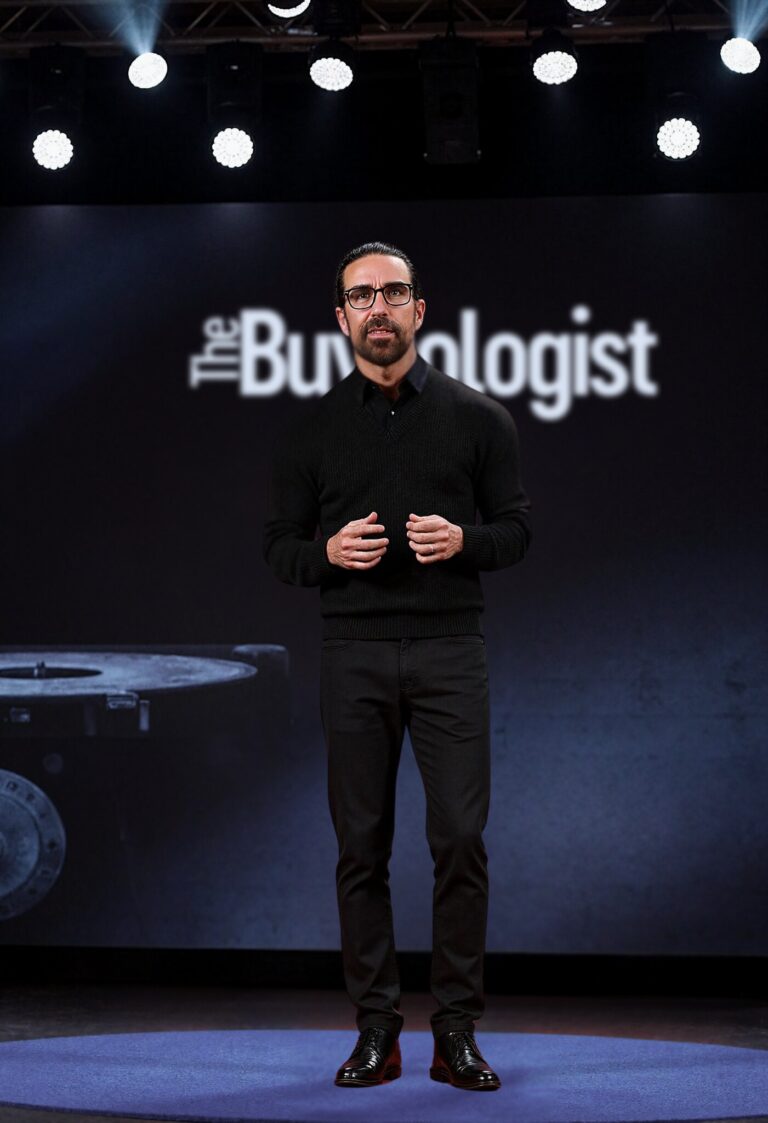
When a professional society for cosmetic surgeons brought in consumer psychologist Dr. Chris Gray to lead a day of workshops, the request was a familiar one: the organization needed more new members, and it was struggling to reach surgeons at the start of their careers.
The group initially framed that challenge as a Gen Z problem. Gray, known as The Buycologist, steered the conversation somewhere more useful. The people the society needed to reach were not defined by a birth year. They were physicians coming out of residency, who could be any age, and the opportunity was to build their interest during residency so that it grew into a desire to join.
That shift, from a generation to a specific group of people and the specific things the organization wanted them to do, shaped the rest of the work.
Start With Who, Then Define What
Gray has spent 30 years studying why people buy, for brands including Walmart, P&G, Coca-Cola, The North Face, and Southwest Airlines, and has designed innovation sessions for companies such as P&G, PepsiCo, and Novartis. Across that work, he begins every engagement in the same place, with what he calls step zero: how well the organization understands the people it is trying to reach.
“Everything I do is predicated on a deep understanding of the target customer,” he says. “It lives or dies based on how well they understand their target.”
From there, he works through what he describes as his equation for influencing behavior: behavior equals motivation and means, plus a call to action. The first step is defining the behavior itself, and organizations almost always start too broad. A goal such as more members or more sales is, in Gray’s view, too broad for a team to build effective strategy around or to measure well.
In consumer packaged goods, he pushes clients to say where new sales will actually come from:
- Are shoppers switching from a competitor in the same category?
- Are they new to the category entirely, in which case trial becomes the priority?
- Are existing customers being asked to upgrade, buy more often, or spend more each time?
Each answer points to a different strategy.
He compares it to setting a destination in a GPS. “The more specific endpoint you put in, the more efficiently you’re going to get there,” he says. “So if someone’s traveling to a specific Chicago hotel and they just put Chicago in their GPS, well, good luck. Locating the specific address and entering that is much less likely to get you lost.”
A Gap Between Valuable and Useful
For the surgeons’ society, defining the behavior surfaced an earlier problem. Before residents could be persuaded to join, they had to pay attention to the society’s marketing in the first place, and much of it was not landing. Earning and holding that attention became one of the group’s strategic priorities.
A small survey of residents sharpened the picture. Going in, one hypothesis was that residents simply did not see the society as valuable. The results suggested something more specific. Roughly 70 percent said the society was valuable, but only about 35 percent could name specific benefits they would receive when joining. Residents were describing a gap, as Gray puts it, between “yes, it’s valuable, but no, I can’t name anything specific that it will do for me.”
Many of the things residents said they wanted were benefits the society already provided but not recognized. The issue was how it described them. The organization was messaging in the abstract, emphasizing prestige and membership in an elite group, while prospective members were judging it in concrete terms: “What, specifically, does this group do for me at my specific career stage?” The society is now in the early stages of rethinking how it speaks to potential members, with messaging that resonates with them and spells out the concrete benefits of joining.
Motivation Without a Path Becomes Frustration
The second part of Gray’s equation pairs motivation with means. Motivation, why the target would want to engage in the desired behavior, has to be defined from the audience’s point of view, not the organization’s. “You’re not your target,” he says. Means covers whatever stands in the way, and the question of how to make the desired behavior an easier, faster, and simpler path to achieving the compelling benefit.
The two have to work together. In workshops, Gray illustrates the point with a bag of money behind a locked door. People who want something they cannot reach (motivation without means) become frustrated, and that frustration tends to land on the brand. Open the door to nothing worth walking through (means without motivation), and the result is apathy.
The society’s survey produced a clear example. Leadership had assumed younger surgeons were less interested in traditional professional rewards such as speaking at conferences, earning podium time, or presenting papers and cases. The residents said otherwise. “They want to do these things. They see that as very aspirational,” Gray says. “They just don’t see a clearly defined path for achieving it.”
Without a visible process, residents could conclude those opportunities belonged only to people with connections. A process did exist; the society had not been explaining it. Here the barrier was means rather than motivation, and the remedy was to make the path as transparent and simple as possible.
The final element, the call to action, is one Gray says many organizations forget. “The power of suggestion works. Use it,” he says. Without a clear next step, the response is left to chance.
Ending With Action
Gray reserves the last part of every workshop for a process he calls Insights to Action. Participants identify specific actions required within each strategic area, rank them by urgency and importance, and assign owners to the tasks.
Before the session, the leadership team had made clear it wanted this retreat to produce action as well as discussion. The session closed with three strategic priorities in the urgent and important category, each with a volunteer who stepped up to lead it.
“Chris stepped into a brand-new consulting relationship and immersed himself in our organization almost immediately. His discovery work was impressive, and he guided our group through a thoughtful look at the barriers in front of us. He built credibility quickly with tremendous energy, a contagious spirit, and valuable insights that won the group over from the start. Our executive team left the engagement with a new sense of clarity, progress toward our goals, and actionable next steps to keep that progress moving forward,” says Mark Theis, CEO of The Aesthetic Society.
Gray does teach theory in his sessions, and he explains why with a kitchen comparison. A cook can follow a recipe but is stuck when an ingredient runs out. A chef understands food science well enough to adjust and improvise. “I want you to be a chef,” he says, because “things never go the way you think they’re going to go. That basic foundational knowledge enables my clients and audiences to be agile and responsive in the face of change rather than stuck.”
For an organization trying to reach a new generation of members, the more useful questions turned out to be narrower ones: what specific people need to specifically do, why they would want to, and what is standing in their way.
More information about Dr. Chris Gray’s workshops and consulting is available on The Buycologist.