Solar-powered persistent flight is one of mankind’s last great aviation milestones, but traditional aircraft architectures are not well suited for the task. A High-Altitude Platform Station (HAPS) must collect enough solar energy during the day to remain aloft throughout the night while running on batteries, which requires an extremely aerodynamically efficient vehicle. Military research programs and aerospace giants have attempted to attain this capability with traditional fixed-wing architectures but have fallen short, leading to canceled programs and unrealized ambitions. However, despite these challenges, one company has embarked on a bold mission to redefine what is possible. With its Tethered Uni-Rotor Network (TURN), Devorto is reshaping aerial systems and unlocking unprecedented opportunities for sustained flight and operational flexibility.
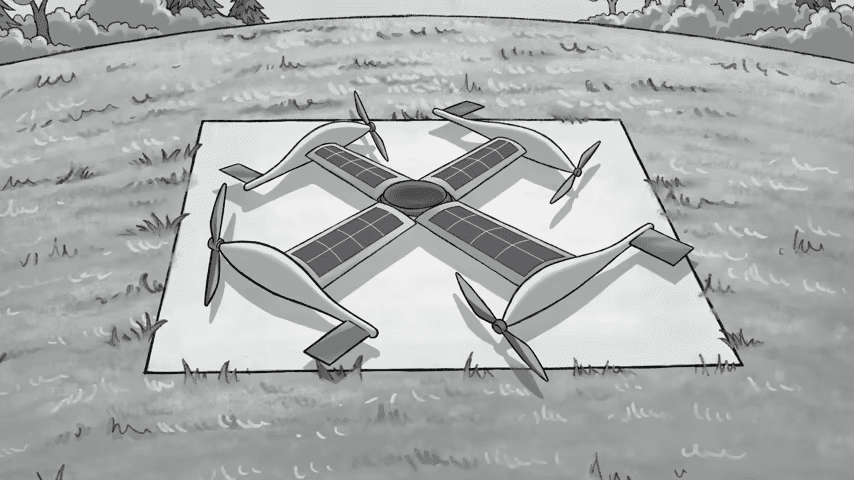
Traditional fixed-wing designs face limitations imposed by the balance between aerodynamic efficiency and structural integrity. Basically, a long, slender wing is crucial to reduce drag, but that requires additional material to reinforce a flexible structure. TURN reimagines this equation by borrowing the physics of a helicopter. Like a rock spinning on a string, system rotation may be used as a design element to place a structure under tension. Devorto’s engineers have adapted this principle to the TURN system, where multiple aircraft are tethered together in a hub-and-spoke arrangement, and the system spins like a helicopter, which places each of the wings under tension.

This paradigm shift in aerial architecture completely changes the design space. It cuts structural material in half, which doubles the amount of battery mass available. It maximizes the aspect ratio of the wing, which minimizes induced drag. It alleviates an adverse bending moment, which increases operational stability. And it permits very thin-thickness airfoils, which have three times better lift-to-drag ratios than conventional aircraft.
When explaining the system’s benefits, CEO Dr. Justin M. Selfridge states, “What this leaves us is an aircraft that still has hover and vertical takeoff, like a helicopter, but it runs on ten times less power than a fixed-wing. That improvement in aerodynamic efficiency means we can attain persistence with more established components. We don’t need to wait for batteries or solar cells to catch up. We can accomplish the task from our improvement in aerodynamic efficiency.”
This increase in aerodynamic efficiency directly impacts the utility of how and where TURN operates. Other HAPS attempts have shown demonstrations at low latitudes close to the Equator and flown during summer, operating under ideal solar conditions. However, providing robust coverage to a wide range of the global population means operating at higher latitudes during the winter months, when the sun is only out for a few hours and doesn’t travel directly overhead. NASA-funded research showed that TURN will be able to operate year-round up to 60-degree latitude, which covers 98% of the global population.
TURN is designed to persist within the stratosphere around 65k feet above the Earth’s surface, which provides an ideal operating environment for TURN. Unlike the denser troposphere below, the stratosphere boasts significantly lower air density, typically around 6% to 7% of that found at sea level. This reduced air density mandates larger wings to operate, which is ideal for providing a large area for solar cells.
Perhaps most crucially, is how TURN mitigates a major shortcoming during ascent and descent. The stratosphere offers a distinct advantage in terms of wind patterns. Unlike the turbulent winds and unpredictable weather systems characteristic of lower altitudes, the stratosphere experiences comparatively stable and benign winds aloft. But a solar-powered aircraft must still traverse the strong winds at lower altitudes to get on station. Unlike other fixed-wing HAPS attempts, which have fallen victim to these stronger winds, TURN keeps its tethers retracted during takeoff and landing. It spins faster in this compact form, which provides significantly better wind robustness from the gyroscopic stabilization.
“The desire for a solar-powered aircraft is we want to get a payload to live persistently in the stratosphere because that will provide better capabilities than satellites, but for the cost and logistics of a drone,” says Selfridge.
Devorto’s TURN aerial platform can achieve unprecedented coverage and persistence by capitalizing on the benefits of its unique architectural design. Its ability to remain aloft for extended periods, maneuverability, and versatility enable TURN to fulfill a diverse range of missions, from telecommunications relay to environmental monitoring and beyond. Whether providing continuous internet connectivity to remote regions or monitoring atmospheric conditions for scientific research, TURN’s presence in the stratosphere promises to revolutionize aerial capabilities.