
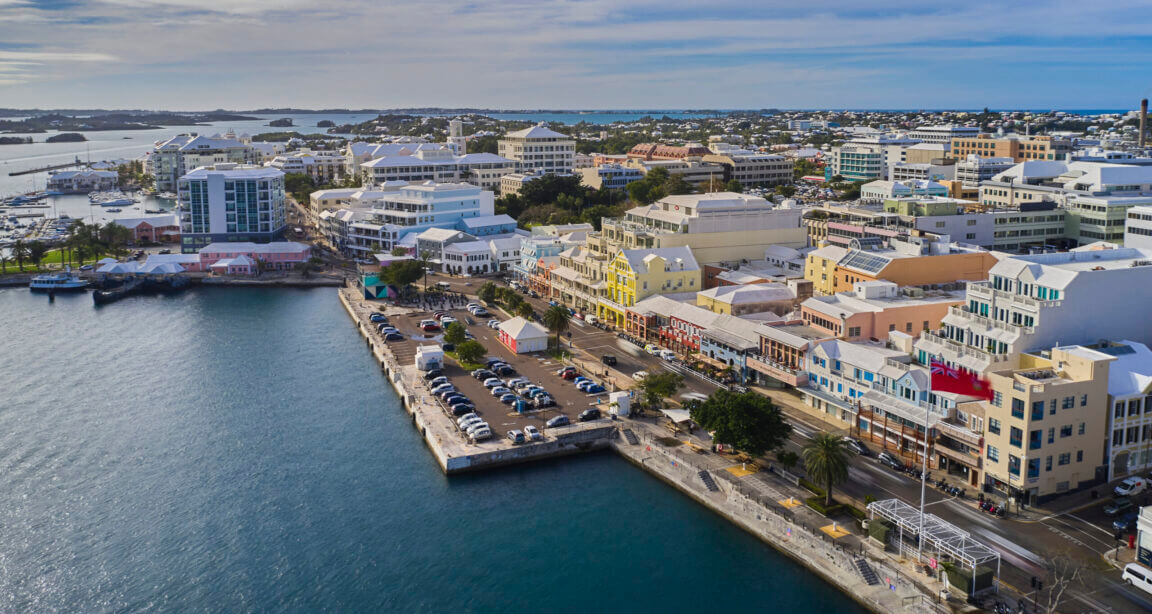
At a moment when a lot of U.S. companies are rethinking how far and how fast they want to expand overseas, Bermuda is making a different kind of pitch.
It is not a story about scale. It is not a story about a low-friction tax haven either, at least not the way David Parker and Steven Rees Davies describe it. What they laid out in a conversation with Kevin Faldu was more specific and, in this market, likely more durable: a jurisdiction that has spent years building credibility in risk, regulation, and cross-border business, then used that foundation to move into digital assets and newer forms of financial infrastructure without abandoning the standards that made it a powerhouse in the first place.
That matters right now. Issues like tariffs and geopolitical strain have made international expansion feel a lot less straightforward than it did a few years ago. But Bermuda, according to Parker, has largely avoided getting caught in that same churn.
Parker, who leads business development at the Bermuda Business Development Agency, came to the island after working in leading financial markets around the world. Initially, he said Bermuda was not an obvious location for the industries he was most familiar with – in fact, like a lot of people, he had to correct his own assumptions.

“I did some homework,” he said. “What I learned was that Bermuda punches way above its weight. It’s got a lot of depth, it’s got a phenomenal ecosystem, a real powerhouse for risk and insurance, now emerging on the global stage of digital assets.”
That line, “punches above its weight,” comes up often around Bermuda, but in this case it is tied to something concrete. Rees Davies, a partner at Carey Olsen who works with the Bermuda government on the island’s digital asset regime, pointed back to the older architecture underneath it all. Bermuda did not become interesting to fintech and digital asset firms in a vacuum. It already had decades of reputation in insurance and reinsurance, plus a regulatory environment with a global reputation.
His view was pretty simple. In today’s volatile global environment, Bermuda sees a huge benefit because of its stability.
“If there’s uncertainty at home in the U.S. or there’s uncertainty abroad, Bermuda is not the uncertain one,” he said.
That may be the cleanest explanation for why the island keeps coming up in conversations around capital formation, digital finance, and specialized financial services. Bermuda is not trying to win by mass appeal. It is winning by being strategic and dependable – with the right audience.
That point was made especially clear when the conversation turned to digital assets. Parker said firms in the sector often tell him they chose Bermuda not because they wanted to avoid regulation, but because they wanted a high standard of it.
“The thing they always say to me is they chose Bermuda because they wanted gold standard regulation,” Parker said. “That’s what actually attracted them.”
That is a useful distinction, because a lot of jurisdictions still talk about innovation and regulation as if they are naturally in conflict. Rees Davies explained that Bermuda avoided that trap early by building a system that recognized technology without pretending the underlying risks were new. In his telling, the island did not try to regulate code for its own sake. It focused on enforcing conduct, mitigating financial crime, maintaining control, and strengthening market integrity, then worked outward from there.
“The reason it happened elsewhere was because we built a regime that was fully comprehensive,” he said. “Those that want credibility, those that saw the future, those that said, we know this is going to go regulated at a financial institution grade style, institutional grade style, as a sector, Bermuda’s going to be the place.”
That approach has given Bermuda an unusually beneficial position in the market. The jurisdiction is small enough to be flexible, but established enough to be influential in the global market. Rees Davies described what they coined the “regulatory sandbox” as a practical expression of that balance. Companies can enter the region under modified or test licenses, prove out their systems, and work with the regulator as they grow and scale. The point is not to wave them through, it is to create a supervised path from idea to credibility.
Parker broadened that concept beyond the formal licensing structure.
“I often think of Bermuda in many respects as the whole island being a sandbox,” he said. “It’s a tiny island, it’s innovation friendly, it’s well regulated. Companies can come to Bermuda, test new ideas, test new solutions before looking to scale them into bigger markets.”
That line helps explain why Bermuda is successful in attracting firms whose ambitions are much larger than the land mass of Bermuda itself. Everyone understands the island’s domestic population is not the extent of the market. The appeal is that companies can build infrastructure, prove compliance, and operate in a regulated environment before expanding to larger jurisdictions when the timing is right.
And in some sectors, Bermuda is not just a proving ground. It is already a real concentration point. Parker noted that 36% of global reinsurance is in Bermuda – more than a third of the global market. So for companies building business-to-business products tied to insurance, capital management, or risk, the island is not only a test market. It is also a place where a meaningful share of the customer base is already physically and institutionally concentrated.
What may be most interesting now is the way Bermuda’s legacy strength in insurance is starting to overlap with its digital asset framework. Parker admitted that when he first arrived, he mentally put those sectors into separate boxes. He no longer sees it that way. The convergence is already happening through life products, collateral structures, tokenized finance, and firms that want to bring digital asset models into regulated, institutional settings.
He pointed to Meanwhile as one example. The company’s model, which connects life insurance with digital assets, did not send its founders on a globe-spanning jurisdiction search.
“What fascinated me about the conversation was, typically in investment promotion, a company expanding its global footprint would have a short list of jurisdictions,” Parker said. “What Townsend said to me, the founder at Meanwhile, was there was only one jurisdiction on his shortlist and that was Bermuda.”
That is the kind of quote investment agencies love, obviously. But in context, it also says something real about Bermuda’s market position. In certain corners of digital finance, it is not merely one option among many. It can be the only jurisdiction that already has the legal, regulatory, and reputational mix a company needs.
The other piece both men returned to was substance. Bermuda does not want to be a mailbox. Rees Davies stressed that companies are expected to maintain real presence, real staffing, and real accountability on the island. That does not always show up immediately in dramatic GDP growth headlines, but it does show up in jobs, office demand, legal work, compliance functions, and service businesses that grow around the sector.
So yes, the island is small. Yes, it lives within broader global currents. But that may be exactly why Bermuda’s current position feels clearer than many other larger jurisdictions. It knows what it is selling: stability, resolve, and the ability to build in a community where the rules are in high regard.
In a market full of noise, that starts to look highly valuable.