

The barriers to building an app have never been lower. New development tools and the rise of “vibe coding” have made it possible for teams to launch products faster than ever. The result is a surge of new apps hitting marketplaces each year.
But while creation has become easier, success has not.
Fresh data suggests the mobile subscription economy is entering a new phase, where a small group of breakout apps captures an outsized share of revenue while the rest struggle to gain traction.
According to Part 1 of RevenueCat’s 2026 State of Subscription Apps report, which examined more than 115,000 apps responsible for over $16 billion in subscription revenue, performance across the ecosystem is becoming increasingly polarized. A small cohort of apps is scaling rapidly, while many others are stagnating or shrinking.
The top quarter of subscription apps grew revenue by roughly 80 percent year over year, far outpacing the rest of the field. By comparison, apps in the middle tier saw only modest growth—around 5 percent—while the bottom 25 percent experienced a 33 percent decline in revenue.
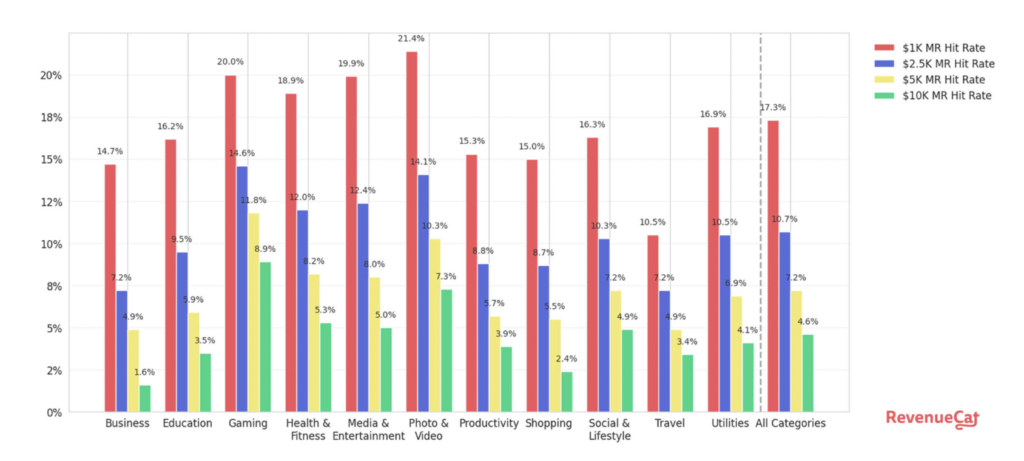
In practical terms, this means the gap between winners and everyone else is widening. Even simply reaching moderate success is becoming less common. Among apps launched in the past two years, only 17 percent managed to reach $1,000 in monthly recurring revenue, down from 19 percent the year prior.
RevenueCat, which manages $1 billion per month in app subscription transactions, representing approximately 20% of all subscription app revenue globally, set out to determine what makes these top performers stand apart from everyone else.
Apps Need to Rethink the Freemium Playbook
For much of the past decade, the freemium model has been the default approach for mobile apps. Users could download an app at no cost, explore its core functionality, and upgrade later if they found it useful.
That strategy helped reduce friction for first-time users and fueled growth. But RevenueCat’s data suggests that giving away too much functionality upfront may actually limit revenue potential.
The study shows that apps using hard paywalls—where users must subscribe before fully accessing the product—convert significantly more users early on than traditional freemium apps.
Median conversion rates for hard-paywalled apps sit around 10.7 percent, compared with roughly 2.1 percent for freemium products. In other words, apps that require payment before granting full access convert users at about five times the rate.
What’s more surprising is that the early advantage doesn’t appear to come at the cost of long-term engagement. After roughly a year, retention rates between the two models converge, suggesting that the users who commit upfront remain just as loyal as those who initially entered through a free tier.
For developers, that finding challenges a long-held assumption: that allowing users to explore for free is always the best path to building a paying customer base.
Pricing Strategy Isn’t a One-Size-Fits-All
If paywalls influence conversion, pricing plays an equally important role in shaping long-term value. But those who succeed aren’t playing copycat. They’re curating strategies based on industry knowledge and defined company goals.
The report finds that higher-priced subscription apps generate substantially more revenue per user in the short term. In their first year, premium apps make $62.19 per user compared to lower-priced apps’ $10.69.
But the advantage comes with a trade-off. Users tend to stay subscribed longer to cheaper apps. Across the dataset, lower-priced subscriptions had a median retention rate of 36 percent, compared with 23 percent for higher-priced apps.
In other words, charging more can drive faster revenue accumulation, but it may also result in a shorter relationship with the average customer.
That dynamic highlights that there is no universal pricing formula for the subscription economy. Some apps may prioritize maximizing revenue per user to offset higher acquisition costs or infrastructure expenses. Others may benefit more from cultivating long-term user loyalty through lower price points. Success depends on an innate understanding of one’s business.
The Vanishing Middle Class
The broader implication of the report is that the mobile app ecosystem is becoming less forgiving.
As the middle tier shrinks, developers who fail to reach meaningful scale face a growing risk of fading out entirely. The explosion of new apps means consumers have more alternatives than ever. For developers, product managers, and growth leaders, the lesson is straightforward. Launching an app is no longer the hardest part of building a sustainable business.
The real challenge lies in designing a monetization strategy that aligns with how users actually behave, whether that means experimenting with paywalls, adjusting pricing tiers, or tailoring subscription models to a specific audience.
In an era where the app economy’s middle class is disappearing, success is less about simply shipping a product and more about building a durable revenue engine behind it.