

Across the country, a new economic layer has quietly formed. Home chefs, resellers, barbers, street vendors, and pop-up entrepreneurs have surged in number — many getting started during the pandemic, many growing afterward. These businesses have grown to have heavy demand but often without the infrastructure or means that more established shops rely on.
Secret World, created by New York native Kaixiong Zhang, was built to give this hidden economy visibility.
The app puts together local deals, microjobs, and independent vendors onto a single map, designed to help people find the opportunities already circulating through their neighborhoods.
Where Zhang’s Vision Began
Raised in New York, Kaixiong Zhang saw at a young age the things regular people do to survive economic pressure, seeing how family and acquaintances earned a living through small exchanges: quick jobs, favors, pop-ups, and neighborhood commerce.
His earliest attempt to build a neighborhood tool was simple: an app people could use to find parking. It didn’t last, as legal barriers shut down the concept, but the experience planted a deeper concept: what if there was a way to organize the messy, often improvised economy people already participate in?
The next inspiration came during the pre- and post-COVID rise of informal vendors, all running businesses without physical storefronts. Zhang saw an entire ecosystem struggling without visibility. Later came the recognition that unskilled workers were also overlooked by most “traditional” gig platforms.
These observations eventually merged into a single direction. Zhang began thinking of a system organized around helping people make, flip, and save money — an “opportunity system,” as he describes it. The idea was to build something flexible enough to support different stages of a person’s life, including:
- Tasks for teens needing fast cash
- Pop-up experiments for new entrepreneurs
- Visibility for local businesses trying to compete
- A single platform flexible enough for all levels of hustle
The name Secret World reflects his view that these informal economies already exist. The app simply puts them in one place where they’re easier to see and access.
Secret World: A Map Where Real-World Opportunities Come to Life
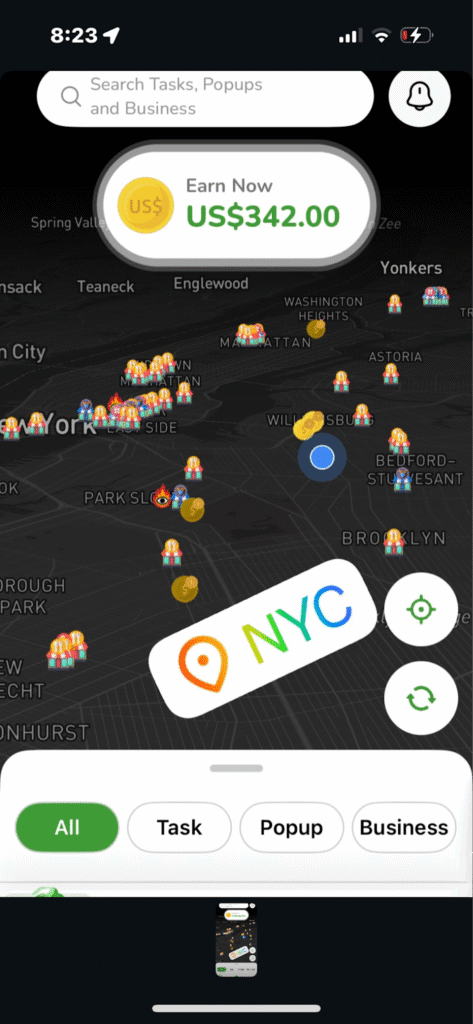
Secret World organizes the local economy through a single interface: a live map.
Instead of treating jobs, deals, and vendors as separate categories, everything appears in one open-world interface. Each icon on the map gives users different kinds of opportunities:
- Coins = quick-cash tasks and microjobs
- Fires = informal vendors, home-based entrepreneurs, and pop-up creators
- Stores = digital storefronts for brick-and-mortar businesses
Inspired partly by open-world games, Zhang sees each icon as a real-life “quest.”
A user tapping a Coin could find a $20 task — checking a location, helping on a small shoot, promoting a product, or participating in a pop-up.
Similarly, a Fire could link them to a home chef selling late-night food, a barber taking private appointments, or a reseller opening a temporary table.
Finally, tapping a Store shows unique deals, specials, and announcements from local shops that use Secret World as their digital storefront.
Every post on the platform goes through manual review so that it adheres to strict legal and safety standards. Businesses are asked to verify themselves with tax documentation, while users are only in charge of messaging each other to set common ground expectations before any exchange.
Instead of a traditional star model, Secret World uses a self-review system: workers first evaluate their own performance, and clients can later confirm that assessment or provide their own — a structure meant to avoid potential bias.
The system is also decentralized by necessity. By avoiding in-app payments, the platform aims to help vendors keep their earnings directly, while avoiding the heavy compliance costs that weigh down traditional gig platforms
For skilled workers (barbers, nail technicians, or cooks), the Secret World app offers a way to reach customers without renting studio space or paying middlemen. For unskilled workers, it gives them better access to microjobs that rarely appear on formal job boards.
Building a Platform Outside the Traditional Startup Model
With no external investors, Zhang funded Secret World himself.
He hired a 12-person engineering team in India and guided design and product development from Brooklyn, and each new iteration required fresh code, new UI, and rethinking core flows.
This extended Secret World’s development timeline into a five-year build, a pace designated not only by resource constraints but also by Zhang’s drive to get a deep and evolving understanding of the informal economy.
All throughout the process, Zhang stayed closely involved in day-to-day development, testing features, reviewing designs, debugging, talking with early users, and adjusting them based on real-world behavior. He’s since continued working on the app’s features, all while assembling materials to show potential investors who’d requested a closer look.
The result is a product shaped by incremental work, built with limited resources, steady revisions, and a clear sense of the community it’s meant to serve.
During this period, cultural figure Windsor Lubin, also known as CEO Slow, took interest in Secret World and joined as a strategic partner, bringing his extensive network in entertainment with him. Ever since, he’s introduced the project to major artists like Bay Swag, Playboy Carti, and Future. These early conversations helped Zhang get a grasp on the potential cultural impact of Secret World and how it could appeal to those who treat hustle as part of their everyday life.
Together, they’re helping position the Secret World app within the broader culture, introducing it to important figures at the street and mainstream levels alike.
Rewiring How Neighborhoods Function
Zhang’s long-term vision for Secret World is to strengthen local economies by keeping transactions closer to home.
He argues that communities lose economic power when everyday exchanges — food, help, quick gigs — get routed through corporate intermediaries. As automation reshapes the job market and living costs rise, the ability for neighbors to support neighbors becomes even more important.
Secret World is designed to reveal the opportunities people already rely on but rarely see:
- A barber working from a rented room
- A baker selling trays from their kitchen
- A home chef feeding night-shift workers
- A teen helping unload boxes for $25
- A local shop offering a same-day discount
As Kaixiong Zhang puts it, “People are already hustling. I’m just mapping it.”
Secret World makes these micro-economies visible — giving residents easier access to the support systems they’ve always used, and helping communities and neighborhoods support each other while driving their businesses forward.